
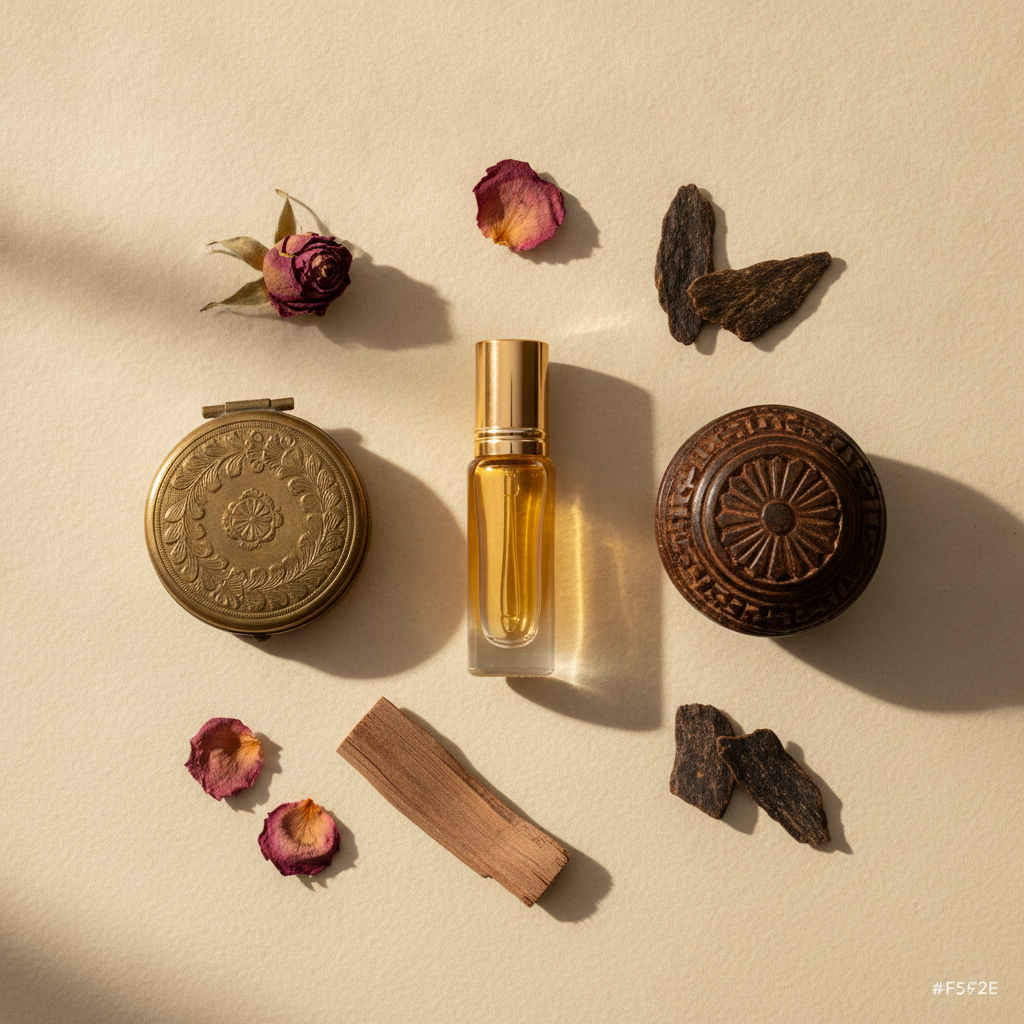
Most perfume conversations start and end with the spray bottle. Which is fair — the alcohol-based eau de parfum or eau de toilette is the default format for almost everything sold in a department store. But if that's all you've tried, you're working with one tool when there are three or four.
Perfume oils, attars, and solid perfumes each do something the spray can't. They're not inferior versions of a "real" perfume — they're different formats with different strengths. Knowing when to reach for each one changes how you wear fragrance entirely.
What makes alcohol-based spray the default
The spray works because alcohol does two things at once: it carries the fragrance up and out (giving you that cloud of scent when you first apply), and then it evaporates fast, leaving the perfume itself behind on your skin. That projection — the way a scent announces itself before someone gets too close — is almost entirely the alcohol doing its job.
Sprays are also easy to layer, easy to preview on a card, and consistent batch to batch. The format is well-suited to the whole infrastructure of how fragrance is sold and sampled.
But alcohol comes with trade-offs. It dries out skin over time, especially for people who apply heavily. It amplifies top notes and then rushes through them. And on some skin types, it can cause irritation or interact with sensitive skin conditions in ways that make wearing fragrance feel more trouble than it's worth.
That's where the alternatives earn their place.
Perfume oils: quiet, close, and long on your skin
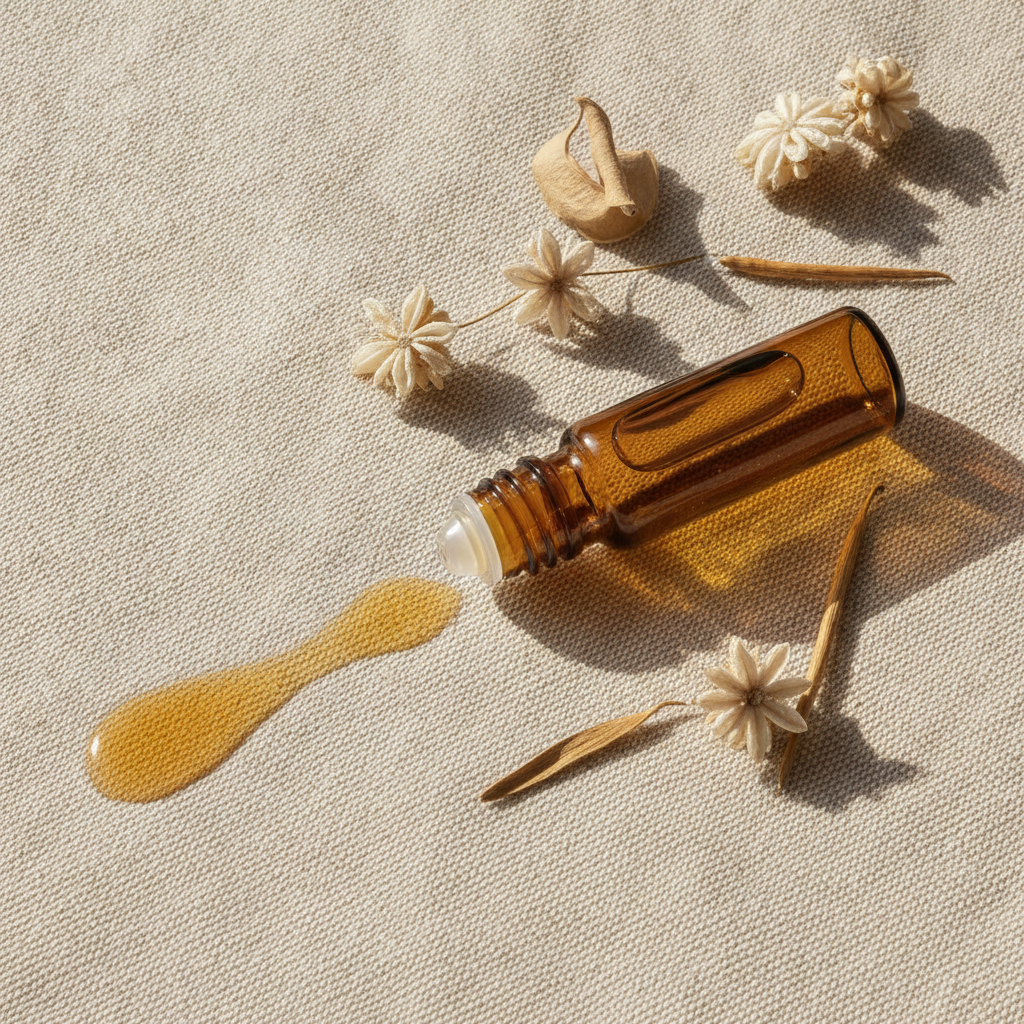
A perfume oil is exactly what it sounds like — the fragrance concentrate dissolved in a carrier oil (jojoba, fractionated coconut, sometimes a neutral synthetic oil) instead of alcohol. No spray mechanism: you apply it directly with a roller ball, a dropper, or a stopper.
The first thing you notice is how it behaves differently on skin. Without alcohol to push it outward, a perfume oil stays close to you. You smell it, the person next to you might catch it, but it doesn't fill a room. This is sometimes called "skin scent" wear — intimate rather than projected.
The second thing is longevity. Oil clings to skin in a way that alcohol doesn't. A well-made perfume oil on moisturized skin can last six, eight, even ten hours without a reapply. The drydown tends to be slower and more linear too — less of the dramatic top-to-base story of a spray, more of a steady, even presence through the day.
Perfume oils suit people with dry or sensitive skin particularly well. The carrier oil is actually conditioning, and there's no alcohol stripping moisture or causing irritation. If you've ever found that a perfume you love smells great in the bottle but harsh on your skin, a version of the same fragrance in oil form often behaves more gently.
The obvious limitation: there's almost no projection. If you want people across the room to notice you've put on a scent, oil isn't your format. And because application is direct skin contact, sharing a tester is less practical.
Attars: the older tradition
Attars (sometimes spelled "ittar") are a subset of perfume oils with a specific heritage — they come from South Asian and Middle Eastern perfumery traditions going back centuries, and the classic method involves distilling flowers or aromatics directly into a sandalwood oil base. The sandalwood acts as both carrier and fixative, and it's part of the scent itself, not neutral background.
Traditional attars — real rose attar, oud attar, musk attars — are some of the most concentrated, expensive, and complex things in perfumery. A single drop of aged rose attar can be extraordinary. But "attar" is also used more loosely now to describe any alcohol-free concentrated oil with a Middle Eastern or South Asian character: heavy florals, resins, oud, amber.
If you've explored houses like Ajmal, Swiss Arabian, or Al-Rehab, you've been in attar territory. Many Lattafa and similar house releases bridge the gap between Western-style concentrations and this older oil-based tradition.
What attars do particularly well: depth, warmth, and skin-fusing longevity. They're designed for close skin wear and they reward patience — the base often only fully emerges hours in. They are not for the office if you're sharing close quarters, and they're not subtle. But for evening, for cold weather, for a moment when you want fragrance to feel like a ritual — they're hard to beat.
Solid perfumes: the case for control
A solid perfume is a wax or balm base (usually beeswax or a similar wax mixed with oils) with fragrance concentrate blended in. It comes in a compact or tin, and you warm a little on your fingertip, then press it to your pulse points.
The projection is very soft — softer even than most oils. Solids are genuinely subtle. Which, depending on the situation, is exactly right.
Think: long-haul flights (where a full spray feels inconsiderate to everyone around you), office environments with fragrance-sensitive colleagues, hospital visits, a yoga class, any enclosed space where you want to smell good but not impose. Solid perfumes let you wear fragrance and still be a considerate human being about it.
They're also the best travel format. TSA-proof, no spillage risk, and small enough to live in a coat pocket. A solid in a brass compact is one of those genuinely practical little luxuries.
The limitation is reapplication — solids don't last as long as oils and need a top-up mid-day. And the scent payoff per application is smaller, so they're not ideal if you want the experience of wearing a complex fragrance in its full form. They're better for a quiet signature than a statement.
Matching the format to the occasion
Thinking about format as a choice — not just a default — opens up how you can dress with fragrance the way you dress with clothing. A heavy attar on a hot commuter train is the olfactory equivalent of a wool coat in July. A shy solid at a black-tie dinner might leave you feeling underdressed.
A rough guide:
Reach for oil when you want longevity without projection, when your skin is dry or reactive, or when you're wearing something you want only you (and whoever's close) to notice.
Reach for attar when you want depth and ritual — evenings, cold weather, moments where you want fragrance to be an experience rather than a finish. Go easy on quantity.
Reach for solid when you need discretion, portability, or a top-up option that lives in your bag without anxiety.
Reach for the spray when you want presence, projection, and the full arc of a fragrance from top notes to base — social situations, outdoors, occasions where the scent is meant to land.
If you're building a collection across formats and want help thinking through what to wear when — what works for a season, an occasion, a particular mood — the Atelier inside TheScentStyler is built for exactly that kind of pairing thinking.
A fragrance you already own in spray form might exist in an oil version that behaves completely differently on your skin. Worth exploring before you assume you've fully met it.
Keep reading The Drydown
The Drydown publishes a new piece most days. If you’d like them quietly delivered, leave your email — no noise, just the writing.
One email per new piece. Unsubscribe anytime.