
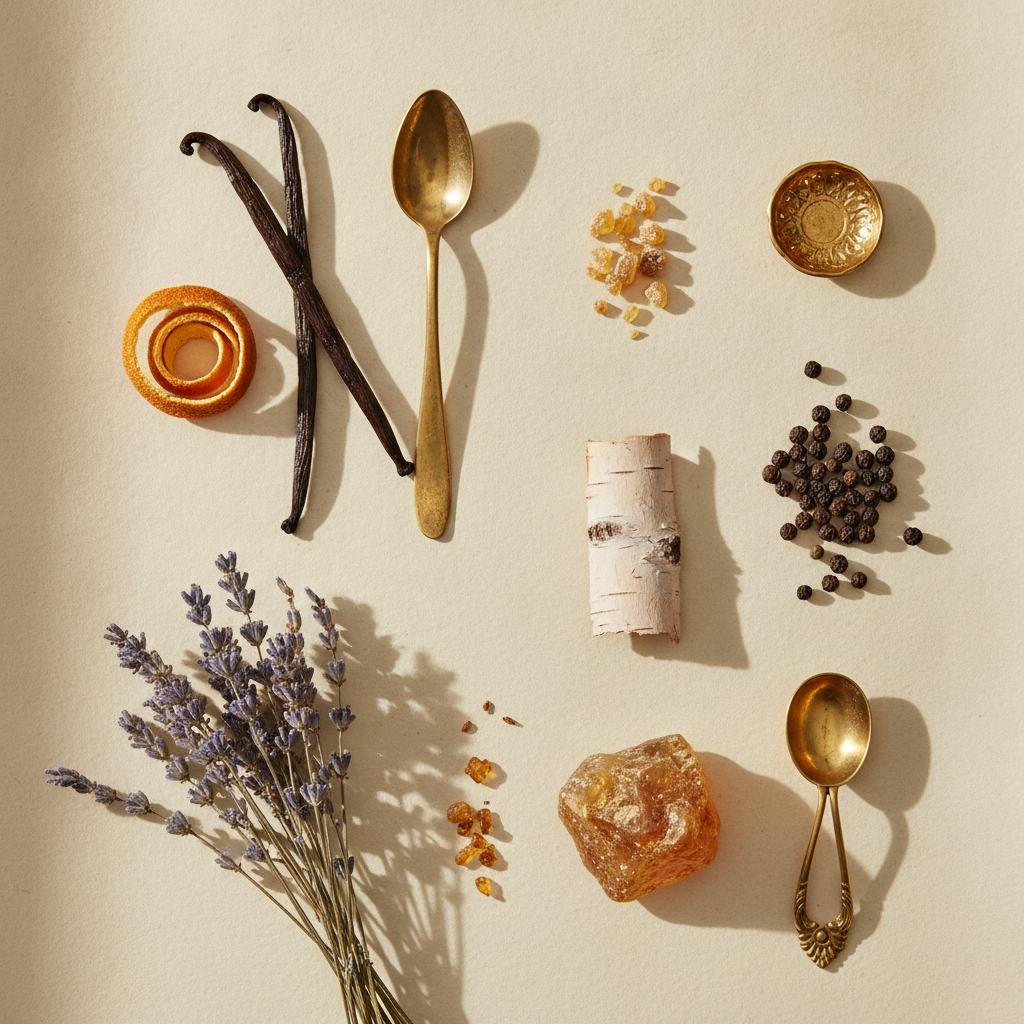
Smell is the sense we're worst at naming. You can point to a colour, hum a tune back, describe a texture in a sentence. But hand someone a strip of unfamiliar perfume and watch them go quiet. "It's… warm? Kind of powdery? I don't know. I like it."
That's not a personal failing. It's how the brain handles scent. Unlike sight or hearing, smell doesn't get routed through the language centres before it hits memory — it goes straight to emotion and association. So you feel a fragrance before you can say it. The words have to catch up.
Here's the thing, though: if you can't name something, you can't hold onto it. You forget the bottle you loved at a department store counter. You can't explain to anyone what you're actually looking for. And you can't track your own taste over time, which is half the fun of having a collection. A little vocabulary changes all of that.
You don't need to learn a perfumer's full toolkit. You need enough words to give a scent a shape.
Start With Families — They're Your Buckets
Before you reach for specific notes, place the fragrance in a rough family. Think of these as containers that give you something to hang the rest on.
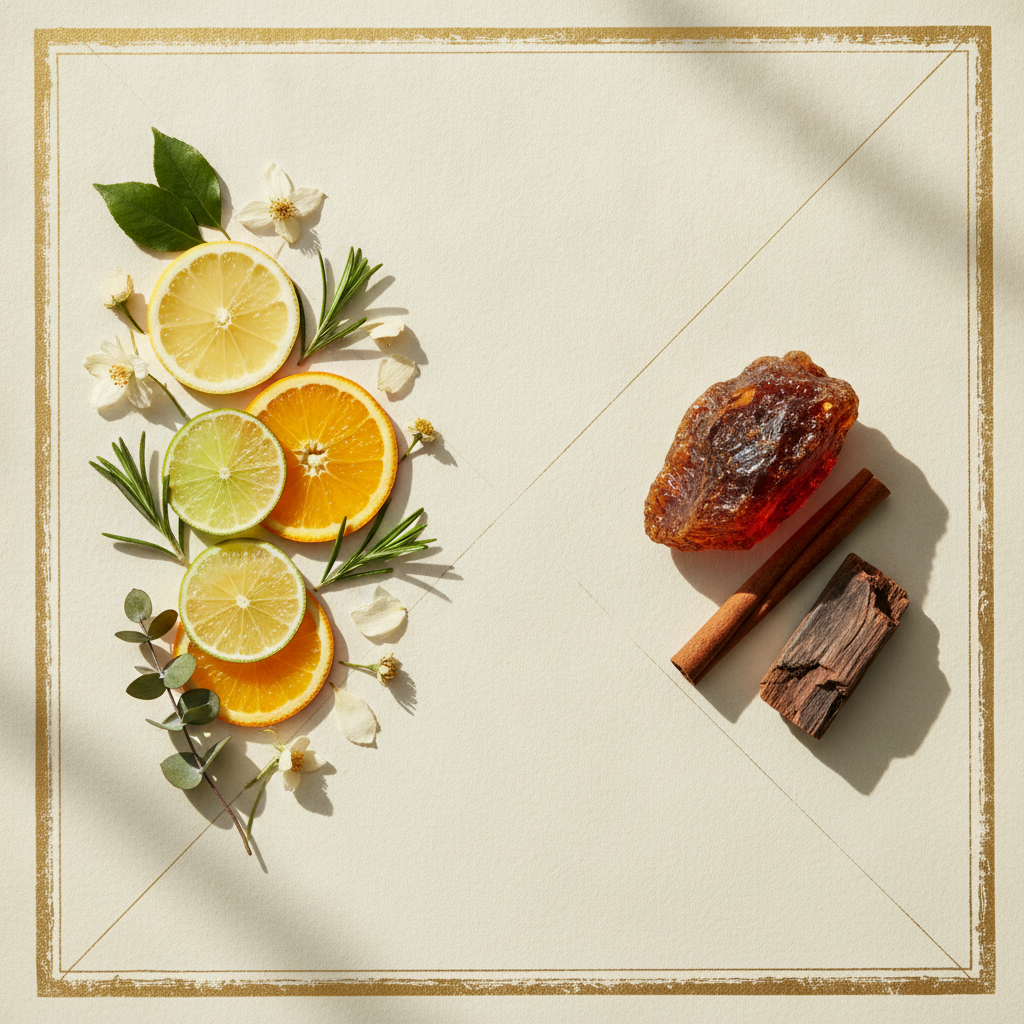
The main ones: floral (flowers, obviously — rose, jasmine, orange blossom), woody (cedar, sandalwood, vetiver, oud), fresh (citrus, green leaves, clean ozonic air), oriental or amber (resins, spice, warmth, sweetness), and fgourmand (edible — vanilla, caramel, coffee, tonka).
Most fragrances blend a couple of these. A floral-woody is a flower sitting on a wooden base — an accord, where separate notes fuse into one impression. A fresh oriental starts bright and dries down warm. Just naming the family — even one — gives you a starting point.
Then Add a Few Simple Axes
Once you have a family, layer in some contrasts. These work for almost any scent:
Warm or cool? Warm fragrances tend toward vanilla, amber, spice, woods. Cool ones lean toward mint, green notes, aquatics, fresh citrus. Some feel room-temperature — that quiet, clean skin-scent category sits somewhere in the middle.
Sweet or dry? Sweetness comes from vanilla, musk, fruit, tonka. Dryness comes from woods, leather, vetiver, tobacco. A fragrance can be warm and dry (woody, smoky) or warm and sweet (gourmand, ambery) — the two axes work independently.
Loud or quiet? This is about projection — how far the scent reaches off your skin. Some perfumes announce themselves when you walk in; others stay close, like a second skin. Neither is better, but knowing which a fragrance is tells you a lot about when to wear it.
Light or heavy? Distinct from loudness. A fragrance can be quiet but dense (a rich oud that stays close), or loud but airy (a fizzy citrus that fills a room and vanishes in an hour).
Cross-Sensory Words Are Your Best Tools
Perfumers use cross-sensory language all the time, and so should you. These are words borrowed from other senses that happen to describe smell really well.
Texture words: soft, velvety, sharp, scratchy, powdery, smooth, rough, silky.
Temperature words: warm, hot, cold, cool, icy, smouldering.
Sound words: quiet, loud, murmuring, buzzing.
Colour words: golden, pale, grey, green, dark.
Taste words: bitter, sweet, salty, dry, clean.
None of these are "wrong." If a fragrance feels grey and quiet to you, write that down. If it feels like warm gold, write that. Your associations are valid description — and often they're more useful than a technical note list.
Record the Association, Not Just the Notes
Knowing a fragrance has bergamot, patchouli, and labdanum tells you what's in it. It doesn't tell you what it means to you.
The more interesting record is: where did this take you? The first time you wore it, what came to mind? A library. Your grandmother's house. Rain on pavement. A specific winter. Smell is the most associative of the senses — it pulls memory up without asking — so lean into that. Write it down.
This is where scent journaling becomes genuinely useful, not just as a habit but as a record. Over time, your entries build a picture of your taste that a note list never could. You start to notice patterns: you reach for the warm, dry ones when you're tired. You want something green and quiet in the mornings. Your favourite bottles tend to sit in the same small corner of that family-axis grid you've been filling in.
That's your vocabulary working. It's not about sounding fluent in perfume. It's about knowing what you're chasing next.

A Simple Practice
Next time you put on a fragrance, give yourself two minutes before you reach for your phone. Sit with it. Then write down:
- What family does it live in?
- Where does it fall on warm/cool and sweet/dry?
- Is it loud or quiet? Light or heavy?
- What does it remind you of, even if the connection makes no sense?
That's it. Four answers. You don't need to name every note — you're not being graded. You're building a personal reference point, one entry at a time, so that six months from now you can look back and actually understand your own taste.
Language doesn't make fragrance better. But it makes it yours in a way that silence can't.
If you want to start keeping that record, TheScentStyler is built exactly for this — log what you wore, write what it brought up, and let the entries accumulate into something you can actually return to.
Keep reading The Drydown
The Drydown publishes a new piece most days. If you’d like them quietly delivered, leave your email — no noise, just the writing.
One email per new piece. Unsubscribe anytime.