
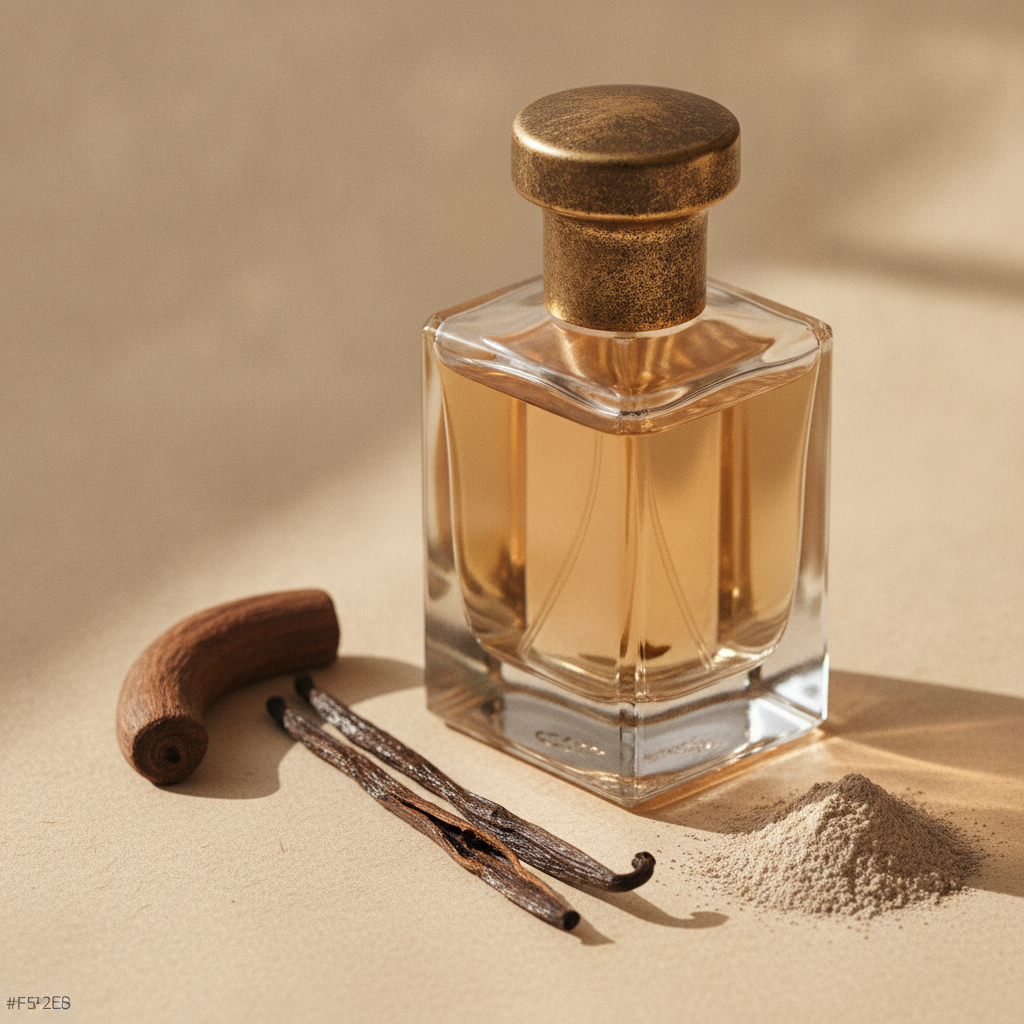
The drydown is the last and longest stage of a fragrance — what is left on your skin once the bright opening notes have burned off, usually from about an hour in and lasting the rest of the wear. It is built from the heaviest, slowest-evaporating materials in the bottle, and for most people it is the part that decides whether they actually like a perfume.
Most people judge a perfume in the first thirty seconds. They spray it at the counter, smell their wrist, decide. That's a little like tasting cake batter and deciding you don't like cake.
What you're smelling in those first moments is only the beginning of what the fragrance is. The part that actually matters — the part that stays with you all day, the part that becomes indistinguishable from your own skin — comes much later. That part is the drydown.
What the drydown actually is
A fragrance unfolds in stages. Most people have heard of the "notes pyramid" — top, heart, and base — but knowing the words and understanding what they feel like are different things.
The top notes hit first. They're bright, sharp, and volatile, meaning they evaporate fast. Citrus, light herbs, fresh green smells — these are designed to grab attention but they're not built to last. Within fifteen to thirty minutes, they're mostly gone.
The heart notes come next. Florals, spices, softer fruits. This is the body of the fragrance, and it carries the scent for the next hour or two.
Then there's the drydown — the base. This is where the heavier, slower-moving ingredients finally come forward: woods, resins, musks, amber, vanilla, vetiver, sandalwood. These are molecules that evaporate slowly and cling to fabric and skin. The drydown is what's left when everything else has burned off.
And it's almost always the best part.
Why it can take hours
"Drydown" sounds like it should take a few minutes. It doesn't. Depending on the fragrance, you might not reach the real base until two, three, sometimes four hours after spraying.
This trips people up, especially when testing. You spray something at a store, it smells a little sharp or generic, and you put it back. But that sharp opening was just the top notes doing their job. The sandalwood or benzoin or warm musk you might have loved — you never gave it a chance to appear.
Some fragrances are almost deceptive this way. They open harsh or strange and settle into something genuinely beautiful. Others open gorgeous and drydown to something flat. You really can't know which you have until you wait.
Weather plays a role too. Heat speeds up evaporation, so on a warm day the top notes burn off faster and you reach the base sooner. In the cold, everything slows down — the whole experience stretches out.
How long each stage lasts
These are ranges, not promises. Concentration changes them, and so does your skin — the same bottle moves faster on warm, oily skin than on cool, dry skin.
Top notes: roughly 5 to 20 minutes. Citrus, light herbs, anything sharp and fresh. These are the smallest, most volatile molecules, and they are gone before most people have left the shop.
Heart notes: roughly 20 minutes to 2 hours. Florals, spices, softer fruits. This is the body of the fragrance and what most people mean when they describe how something smells.
Base notes — the drydown: from about 1 hour onward, often 4 to 8 hours or more. Woods, resins, musks, amber, vanilla. On a heavy extrait this can still be there the next morning; on a light eau de toilette it may be quiet by mid-afternoon.
The overlap is the point. A fragrance does not switch stages like gears — the base is already there underneath the opening, it is just outnumbered. What perfumers call a note and what they call an accord matters here, because the drydown is usually an accord doing the work rather than any single ingredient.
How to judge a fragrance by its drydown
Spray it on skin, not on a paper strip — paper has no warmth and no chemistry, so it only ever shows you the opening. Then leave it alone. Smell it again at about an hour, when the heart has settled, and again at four hours or more, when the base is all that is left. If you still want it on you at hour four, that is the answer. Buying on the first thirty seconds is how people end up with bottles they never reach for.
How to actually experience it
The best way to test a drydown is simple: spray on skin (not paper, which doesn't interact with your chemistry the same way), and then go do something else. Come back in two hours. Smell your wrist again.
That's it. The challenge is patience, not technique.
If you're at a counter, this is hard to do. Buy a sample, or ask for one. Wear it for a full day before you decide. A lot of the best fragrance decisions come from wearing something to bed and noticing what it smells like when you wake up — faint, warm, entirely settled, entirely you.
It also helps to know what's in the base before you try something. If a fragrance lists vetiver and birch tar in the base, and you already know you find smoky things hard to wear, that's useful information. If it lists vanilla, tonka, and musk, and that's your comfort zone, the drydown is probably going to feel like home.
This is where keeping a catalog pays off. When TheScentStyler's Librarian fills in a fragrance's notes for you — top, heart, and base — you start to see patterns in what you actually reach for. Over time, you learn which base notes are yours. And you stop wasting time on things that were never going to get there.
The part that becomes you
There's a reason the drydown is personal in a way the opening isn't. The base notes are the slowest and the most intimate — by the time you're in full drydown, the fragrance has been reacting with your skin's warmth and chemistry for hours. Two people wearing the same perfume will often smell meaningfully different by hour three.
This is also why some fragrances feel like yours in a way others don't. It's not just preference — it's that the drydown genuinely merged with something about you. The top notes are the same on everyone. The drydown, less so.
So if you've been testing perfumes by the sniff-and-decide method, it's worth slowing down. Give a fragrance a full day. Judge it by what it leaves behind, not what it announces.
The drydown is where it gets interesting. It's also, not coincidentally, where you find out whether something is actually worth keeping.
If you want to start tracking the base notes that keep showing up in your favorites, TheScentStyler builds that picture for you automatically — the Librarian pulls in a fragrance's full note breakdown the moment you add it to your collection. After a few bottles, you'll know exactly what your drydown is made of.
Keep reading The Drydown
The Drydown publishes a new piece most days. If you’d like them quietly delivered, leave your email — no noise, just the writing.
One email per new piece. Unsubscribe anytime.