
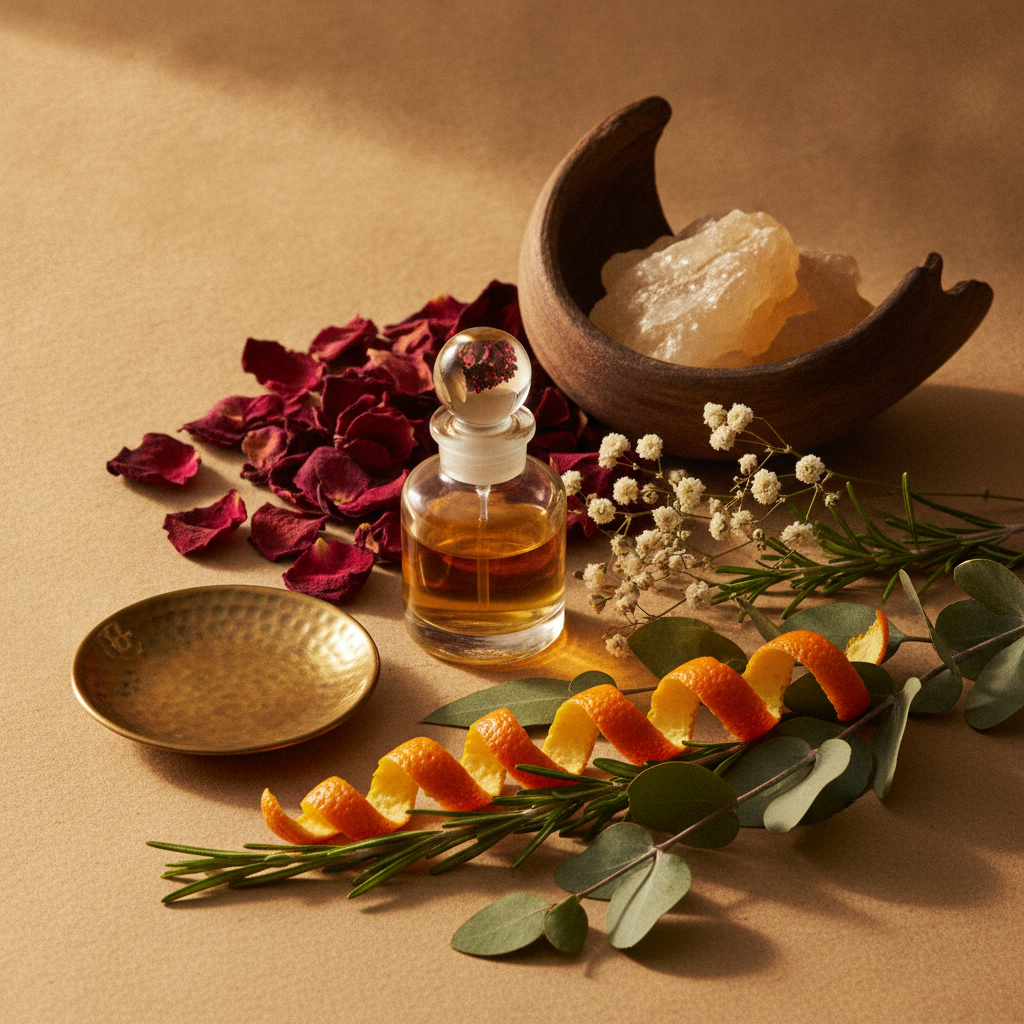
You're standing at a fragrance counter and a note card says something like: Top: bergamot, pink pepper. Heart: rose, iris, jasmine. Base: sandalwood, musk, vetiver. It sounds precise and official. It should tell you what you're getting into.
Except you spray it, and it doesn't smell like any of those things — or it does, sort of, but not at the same time, and then it changes, and by the afternoon it's completely different from what you smelled at the store.
That's not a failure of your nose. That's the pyramid working exactly as intended. The note list just didn't explain itself. Part of the gap is that a note and an accord aren't the same thing.
Here's what it's actually telling you.
The pyramid is a timeline, not a recipe
When perfumers talk about top, heart, and base notes, they're not describing ingredients the way a chef lists them. They're describing a sequence — three rough acts in the life of a fragrance on your skin.
The top notes are what you smell first. They're the opening impression, the thing that hits you when you spray and lean in. Citrus, light herbs, bright florals, green things — these are classic top notes because they're made of volatile molecules that evaporate quickly. On skin, most top notes are largely gone within twenty to forty minutes.
This matters because top notes are what you smell in the store. They're doing a specific job: getting your attention. That's not cynical — a good opening is genuinely part of a fragrance's character. But if you only ever smell something at the counter and buy based on that, you're judging a book by its first page.

The heart notes — sometimes called the middle notes — are where the fragrance actually lives. They emerge once the top has faded, usually somewhere between thirty minutes and an hour after application, and they tend to stick around for a few hours. Florals, spices, lighter woods, green or aromatic elements — these are common heart territory. The heart is the scent's personality. It's what you notice when someone passes you in a hallway two hours after they got dressed.
The base notes are the foundation, and they're slow. They don't fully show themselves until the top and heart have had their moment. Musks, heavy woods, resins, vanilla, ambers — these are base-note materials because their molecules are large and heavy and cling to skin and fabric. They're what you smell when you pick up a sweater you wore three days ago. They're also what makes one fragrance stay close to your skin all day while another fills a room.
The base is often what makes you fall in love with something on second wear — once you've actually gotten there.
Why this doesn't always work the way the card says
A few things complicate the pyramid in real life, and it's worth knowing them.
First, perfumers don't always build strict pyramids anymore. Some modern fragrances are intentionally linear — they smell more or less the same from first spray to last — because that's a valid creative choice. The pyramid is a useful framework, not a law.
Second, concentration affects how fast things move. An eau de parfum tends to unfold more slowly and last longer than an eau de toilette. A pure parfum can feel like it barely has a top note — it opens so richly that you're practically in the heart from the start.
Third, your skin changes everything. Body heat, pH, hydration — all of it interacts with fragrance chemistry. What reads as a sharp citrus opening on one person softens into something almost floral on another. The base notes that cling for eight hours on dry skin might fade in four on oily skin, or vice versa. There's no single correct experience of any fragrance.

The skill is just paying attention
Once you know about the pyramid, your job is simple: slow down and notice.
Spray something in the morning before you leave the house. Smell it immediately — that's the top. Go about your day. Check in around the one-hour mark — that's closer to the heart. Smell your wrist late afternoon, or the inside of your elbow. That's where the base lives.
Do this a few times with any fragrance you're curious about, and you'll start to build a real sense of its character — not the marketing version, but the lived one. You'll also start to notice which phase you actually like most. Some people fall for openings. Others only care about what's left after six hours. Knowing which you are saves you money.
Keeping notes as you go makes a surprising difference. Even something brief — opens bright and a little sharp, settles into something creamy and warm by afternoon, base is soft, skin-close — gives you something to return to. That's the kind of detail that helps you figure out what you actually reach for, and why. It's also the kind of thing TheScentStyler takes off your hands with its Librarian feature, which fills in the notes and DNA of any fragrance in your collection so you don't have to do the research from scratch every time.
The note list is a map, not the territory
Next time you read a fragrance pyramid, treat it as a rough guide to a journey, not a guarantee of what you'll smell. The top is the door. The heart is the room. The base is where you stay.
The only way to really know a fragrance is to wear it and pay attention. That's a skill — and it's one you build every time you bother to notice.
If you want a place to track those noticings, TheScentStyler's Librarian builds out the full profile of every bottle you own, so your collection has context and not just names. It's a small thing that makes looking back at what you've worn actually mean something.
Keep reading The Drydown
The Drydown publishes a new piece most days. If you’d like them quietly delivered, leave your email — no noise, just the writing.
One email per new piece. Unsubscribe anytime.