

Most people find their favorite perfumes by accident. They smell something on a friend, or pick up a tester on a whim, and suddenly they just know. But ask them to explain what they love about it, or find something similar, and things get fuzzy fast.
That's where fragrance families come in. They're a simple map — not a rigid system, not a test you can pass or fail — just a way of grouping scents that share a common character — characters built from accords, not the single notes on the box. Once you understand them, you stop wandering the fragrance counter hoping to get lucky. You start to recognize what you're actually drawn to.
The Main Families
Think of these as neighborhoods, not strict categories. A perfume can live in more than one.
Fresh — Clean, light, airy. This is the family of ozonic scents (that just-rained smell), citrus openings, aquatics, and green notes like cut grass or cucumber — much of which lives in the fleeting top of the pyramid. Fresh fragrances tend to feel effortless and unobtrusive. They're popular for daytime, warm weather, and people who want to smell like they just got out of the shower — in the best possible way.
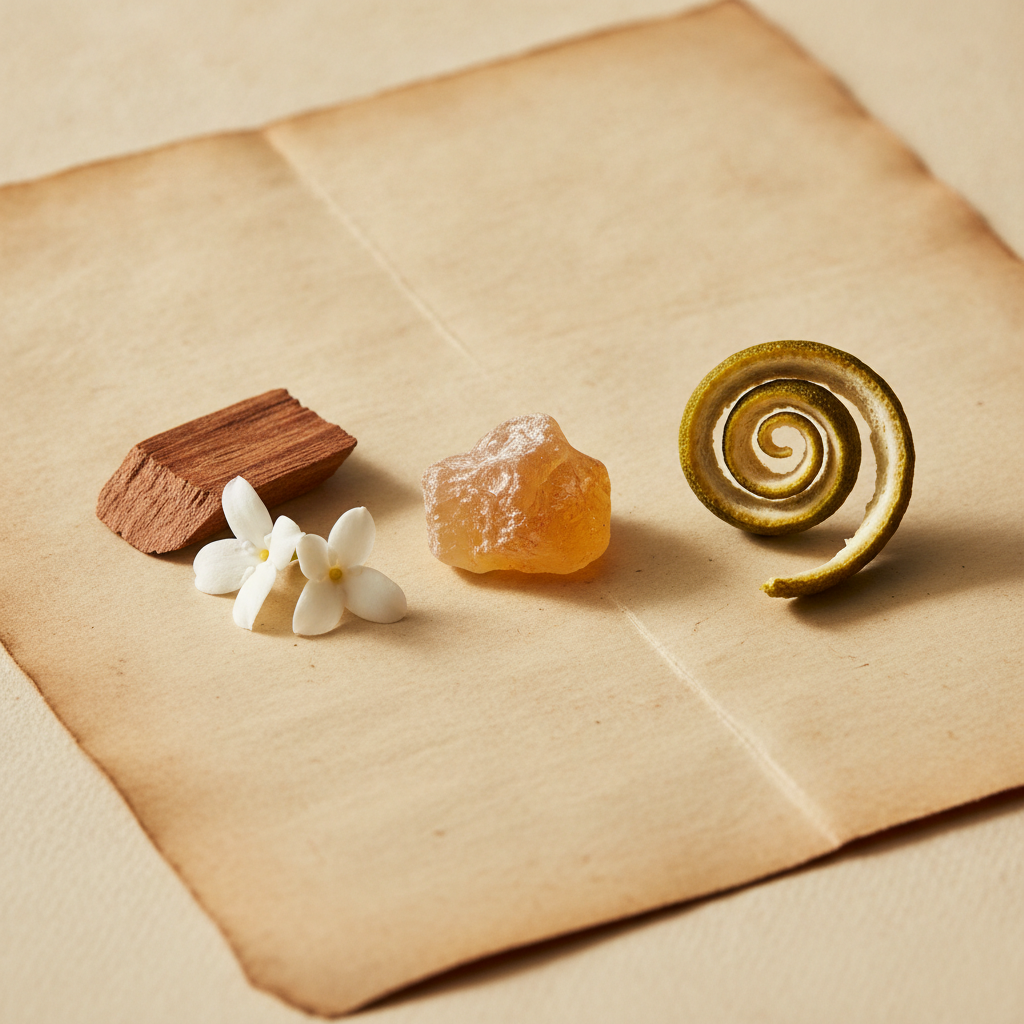
Floral — The largest family by far. Anything where flowers are the heart of the story. Rose, jasmine, peony, iris, lily of the valley — and the modern rose has moved a long way from the soapy stereotype. Some florals are lush and heady; others are sheer and barely there. If you've ever said you want something "feminine and classic," you were probably describing a floral — though florals belong to everyone.
Woody — Warm, grounding, earthy. Cedar, sandalwood, vetiver, patchouli. These are the notes that feel like walking into a forest or sitting near a fire. Woody fragrances have a natural, almost physical weight to them. A lot of niche houses lean heavily here.
Amber / Oriental — Rich, warm, and enveloping. Vanilla, resins, musks, spices. These are the fragrances people describe as "cozy" or "seductive" — the ones that project and linger. Amber-family scents tend to be evening-friendly and work especially well in cold weather. Many of the most-loved Lattafa and Oakcha releases live in this territory.
Gourmand — A branch of the amber family that leans edible. Think caramel, chocolate, coffee, tonka bean, or a house that specialises in them. Not literally food — more like food as a feeling: warmth, sweetness, comfort. If you've ever been complimented on smelling "good enough to eat," you were probably wearing something gourmand.
Fougère — A word borrowed from French for "fern," even though it doesn't really smell like ferns. It's more of a classic masculine accord: lavender, oakmoss, and coumarin (a warm, hay-like note). Most traditional men's colognes from the 20th century are fougères. Many people wear them without knowing the name.
Chypre — One of the oldest and most sophisticated families. Built on a base of bergamot, labdanum, and oakmoss, chypres have a mossy, dry, slightly bitter quality that feels polished and complex. They've made a comeback through niche houses and reformulations. If you love something that feels "serious" or "intellectual," it might be chypre.
How to Find What You Already Love
Here's the thing: you probably already have a home family. You just haven't named it yet.
Think about the last five perfumes you reached for without overthinking it. What did they have in common? Were they light and breezy, or deep and warm? Did they feel like outdoors or indoors? Did anyone ever say you smelled like clean laundry, or like a bakery, or like a forest?
Those gut responses are data. They're telling you something.
If you're building a collection, try to notice the pattern. A lot of people think they own a random mix of bottles until they look at them as a group — and suddenly there's a clear through-line. Everything leans warm. Or everything is fresh and clean. Or there's a dozen florals in a row without you planning it that way.
That pattern is your taste. It's worth knowing.
Why It Matters for Shopping
Once you can name what you gravitate toward, a few things get easier.
You can shortcut blind buys. If you know you love amber and gourmand scents, a fresh aquatic might not need to be your next purchase, even if it's getting great reviews. Reviews are useful, but reviews from people who love what you love are better.
You can layer more intentionally. Putting a fresh citrus on top of a woody base, or a floral over an amber, is the kind of pairing that makes sense once you understand why certain families sit well together.
And you can communicate better — to shop assistants, to fragrance communities, to yourself. "I love warm vanilla scents but I don't want anything too sweet" is more useful than "I want something good."

The Easiest Way to See Your Own Pattern
If you already own more than a handful of bottles, you have everything you need. The pattern is sitting right there in your collection — you just need to look at it all at once.
TheScentStyler has a feature called the Librarian that fills in the notes and DNA of any fragrance you add to your catalog. You don't have to research anything manually — it just happens. Once your bottles are in there, the families show up on their own, and your tendencies become obvious in a way they never are when the bottles are just lined up on a shelf.
It's a small thing. But seeing your own pattern clearly is the kind of thing that changes how you shop, how you layer, and honestly, how you think about your own taste.
If you haven't mapped your collection yet, that's the natural place to start. Add what you own, let the Librarian fill in the details, and see what comes back. Your fragrance family — or families — are probably already there waiting.
Keep reading The Drydown
The Drydown publishes a new piece most days. If you’d like them quietly delivered, leave your email — no noise, just the writing.
One email per new piece. Unsubscribe anytime.
Comments
One response to “Fragrance Families, Explained — and How to Find Yours”
[…] most of its life it’s been defined by one move: make sweetness the entire message. (If the fragrance family map is new territory, that primer sits underneath everything […]