
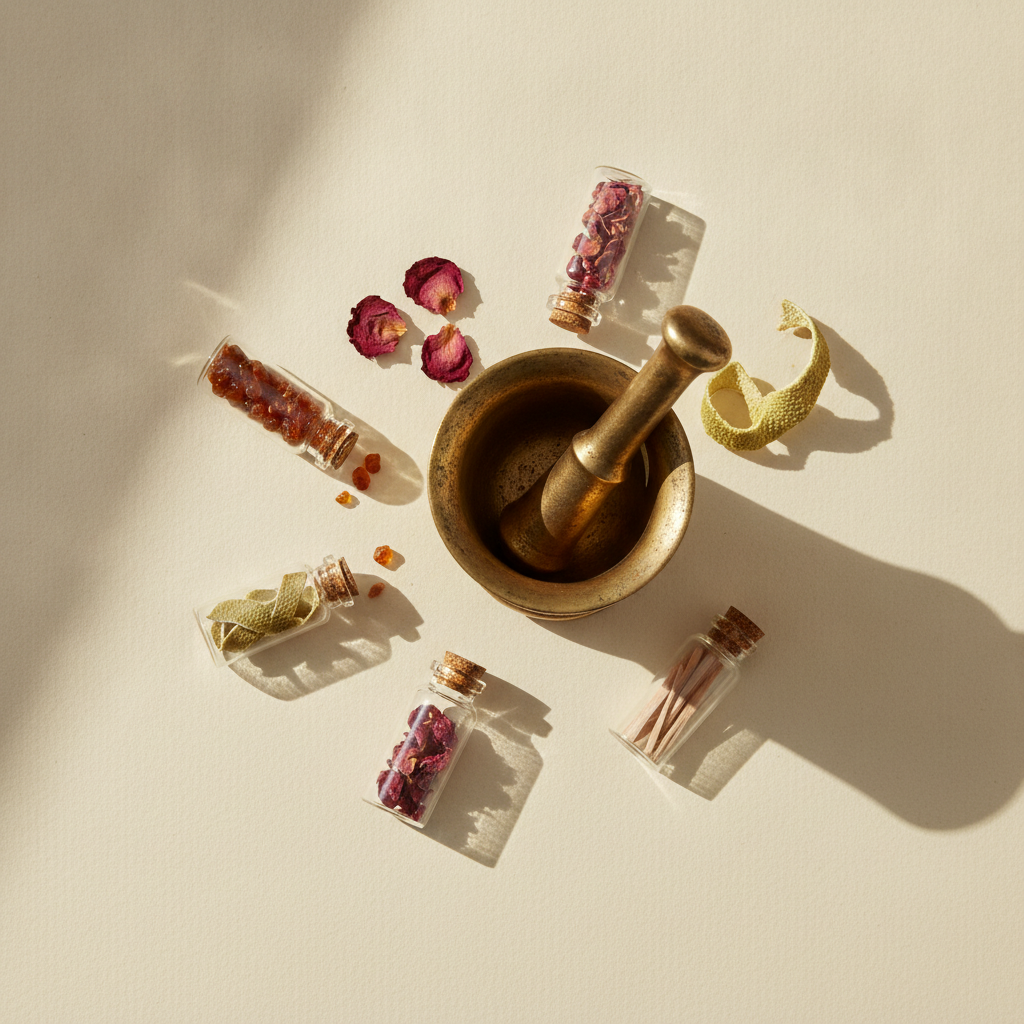
You pull up a fragrance online — or flip the box over at a counter — and there's the note list. Bergamot. Jasmine. Vetiver. Amber. It sounds like a recipe, so naturally you expect to smell those things, one by one, maybe in that order.
Then you spray it and smell… none of them, really. Something warmer. Something soft and vaguely smoky and a little floral, but not jasmine exactly. Nothing that says "bergamot" the way a bergamot should.
That gap between the list and the actual smell trips up a lot of people. It's not that you're smelling wrong. The list just doesn't show you the full picture.
A note is one ingredient. An accord is what it becomes with others.
A note is a single aromatic material — natural or synthetic. Bergamot is a note. Rose is a note. Vetiver, cedarwood, musk, vanilla: all notes. When perfumers talk about notes, they mean individual building blocks, the separate raw materials in the formula.
An accord is what happens when you blend some of those notes together and they stop reading as separate things. They fuse into one impression — something that has its own identity, something a nose can perceive as a single smell even though it's technically several.
Think about how a chord works in music. C, E, and G played separately are three notes. Played together, they become one sound with its own character. A musical chord is named for what it is, not for the three notes pressed underneath it. A fragrance accord works the same way.
A classic example: the "marine" accord. There is no ocean ingredient. No one is squeezing seawater into a bottle. A marine accord is usually built from a handful of synthetic materials — often including something called Calone, which has that airy, slightly metallic sea-air quality — combined with other notes in proportions that together read as "the beach." You smell one thing. Behind it are several.

Why the note list doesn't match what you smell
The ingredient list on a box is real — those things are usually in there. But it lists notes, not accords. And what a perfumer actually builds is a structure of accords, layered on top of each other.
By the time those individual notes are combined, balanced against each other, and then put on skin with heat and natural oils in play, what reaches your nose isn't the individual ingredients anymore. It's the finished, merged impression — the accord — that the perfumer designed.
A rose note in isolation smells like a rose. The same rose note alongside patchouli, musk, and a touch of saffron smells like something darker, earthier, more complex. The rose is still in there, but it's working as part of something bigger. You might not even register it as rose.
That's why people often say a fragrance doesn't smell like its listed notes. It does — but only in the way a cake contains flour and sugar and eggs. Those are the ingredients. The cake is what they become.
Thinking in accords changes how you talk about perfume
Once you understand accords, you can describe what you're smelling more accurately. Instead of reaching for an ingredient you can't quite locate, you start naming impressions: this has a warm, powdery drydown, almost talc-like — that's an accord. There's this green, dewy quality at the opening — that's an accord. Something creamy and sweet underneath, like a dessert without being heavy — also an accord.
Common accords you'll hear about: marine, gourmand (sweet and edible-leaning), animalic (warm and skin-like), chypre (earthy, mossy, a bit tart), fougère (fresh, herbaceous, classic barbershop territory). These are family-level impressions built from multiple notes working together.
Knowing this also helps when a fragrance surprises you. If you buy something listed as a "rose soliflore" and it smells more like a red fruit with a powdery finish, it's not that the rose is missing — it's that the perfumer built it into an accord that emphasizes other facets. The rose is holding hands with something else.
The note list is a starting point, not a spoiler
It's still worth reading. Notes give you a rough map of a fragrance's territory — a list heavy in citrus and aquatic materials tells you something different than one full of resins, woods, and musks. But read it as a list of ingredients, not a list of things you will smell.
What you'll actually smell is the perfumer's vision — the finished accords, blended together, playing off your skin chemistry, unfolding over time.
When you're building out your collection, it helps to keep track of not just what notes a fragrance lists, but what it actually smells like to you — the impressions, the accords, the moods. TheScentStyler does some of that work for you through the Librarian, which fills in a fragrance's DNA and notes so you're not left staring at a box trying to parse the list alone.
The more you pay attention to accords rather than hunting for individual notes, the more clearly you'll be able to read a new fragrance — even one you've never smelled before.
Keep reading The Drydown
The Drydown publishes a new piece most days. If you’d like them quietly delivered, leave your email — no noise, just the writing.
One email per new piece. Unsubscribe anytime.