
Most perfume regrets follow a predictable pattern. You smelled something beautiful — on a blotter, on a friend, in a warm shop — bought the full bottle, got home, and wondered what happened. The scent you fell for isn't quite the one living in that bottle now.
It's not that you were wrong. It's that you didn't give it enough time, or the right conditions, to show you what it really was.
Here's how to avoid that.
Blotters are for shortlisting, not deciding
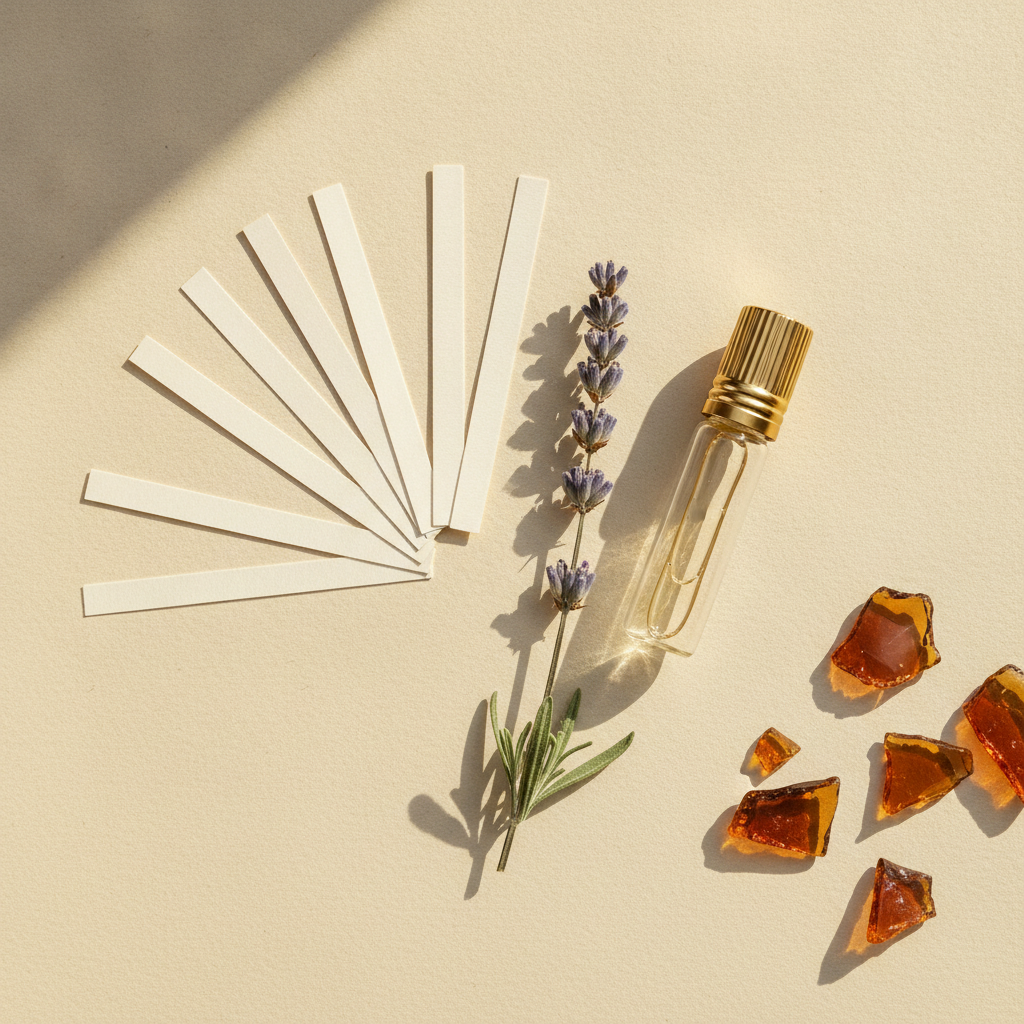
When you walk into a store and start testing, blotter strips are fine for the first pass. They're how you figure out what's worth investigating. A quick spray, a sniff — does this smell interesting? Is it in the right territory? Knowing which fragrance family you gravitate toward makes that first pass faster. Does it make you want more?
That's the only question a blotter can answer.
What a blotter can't tell you is how the scent will actually smell on you, how long it will last, how it behaves when it warms against skin, or what it turns into an hour in. The paper is just a preview.
If something catches you on a blotter, that's your cue to go further — not your cue to buy. Testing well is how you land on a signature scent worth committing to.
The first five minutes are a trap
Fragrance is built in layers. The top notes — usually the brightest, sharpest, most immediately appealing parts — are also the most volatile. They're designed to hit fast and fade fast. What you smell in the first five minutes is almost always the least representative version of a fragrance.
The part that will actually live on your skin for hours is what develops after those top notes burn off. That's called the drydown, and it can smell completely different. A scent that opens with a blast of citrus might settle into something earthy and dark. Something that smells clean and fresh upfront might go powdery and sweet once it's on you for a while.
So: spray it on your wrist, then go do something else. Come back in twenty or thirty minutes. Come back again after an hour. That's the perfume you'd be living with.

Don't test too many at once
There's a limit to how many fragrances your nose can meaningfully evaluate in one session. Most people hit a wall somewhere between three and five — after that, everything starts blurring together and your assessments become less trustworthy.
If you're at a counter and you've already tried four or five things on skin, stop. You're not going to get useful information from numbers six and seven. Come back another day, or at least give your nose a real break — not a coffee bean sniff, which mostly just masks rather than resets. Fresh air and time work better.
The practical rule: two or three on skin per outing, no more. Everything else gets a blotter shortlist to revisit later.
Decants and samples are the real money-savers
This is the one habit that will save you the most over time. Before you commit to a full bottle — especially anything over sixty or seventy dollars — get a sample or a decant first.
A decant is a small quantity of a fragrance (usually 2–10ml) transferred from a full bottle, sold by specialist retailers or community members. Samples are often the official ones from the brand. Either way, they let you wear something multiple times, on multiple days, in multiple moods, before you decide it's worth a full bottle.
Because context matters. A fragrance you love on a warm Saturday might feel wrong on a Tuesday morning in a small office. Something that seemed too heavy in summer might become your favorite in January. A few wears across different situations tells you so much more than one store visit ever could.
There are dedicated decant sites and fragrance communities built around exactly this. It's a small upfront cost — usually a few dollars — for a lot of clarity. Come December, a fragrance advent calendar does the same job in a more festive package.
Keep track of what you've tried
Once you start sampling seriously, the names and impressions start blurring. You'll forget whether you liked the drydown on that one oud you tried, or whether you gave that iris sample a fair shot. Notes on your phone help, but they get messy fast.
A proper catalog makes a real difference here — somewhere you can log what you've sampled, what you thought at each stage, and whether it earned a full bottle. TheScentStyler does this, and its Librarian feature fills in a fragrance's notes and scent DNA automatically so you're not doing the research yourself every time.
The rule that ties it all together
Blotter to narrow it down. Skin to really evaluate. Time to let the drydown speak. Samples before full bottles. And never more than a few at once.
It sounds like more effort than just buying the bottle. But it's dramatically less effort than owning ten bottles you don't reach for.
When something finally earns its place in your collection — because you wore it five times and still wanted more — that's a very different feeling from hoping you made the right call at the counter.
If you want a place to track what you're sampling and build toward a collection you actually love, the TheScentStyler app is built for exactly that — catalog what you've tried, log your impressions, and let the Librarian handle the note-filling so you can focus on the wearing.
Keep reading The Drydown
The Drydown publishes a new piece most days. If you’d like them quietly delivered, leave your email — no noise, just the writing.
One email per new piece. Unsubscribe anytime.
Comments
2 responses to “How to Test Perfume Before Buying (And Stop Wasting Money on Bottles You’ll Regret)”
[…] wear it? If the answer is specific, buy it with joy. If the answer is “it went viral,” test it properly first and let the drydown […]
[…] than any other category — which is why gourmands are at their best in a fall and winter rotation. Test on skin, across a full drydown, before any bottle commitment. The counter sniff lies hardest with […]