
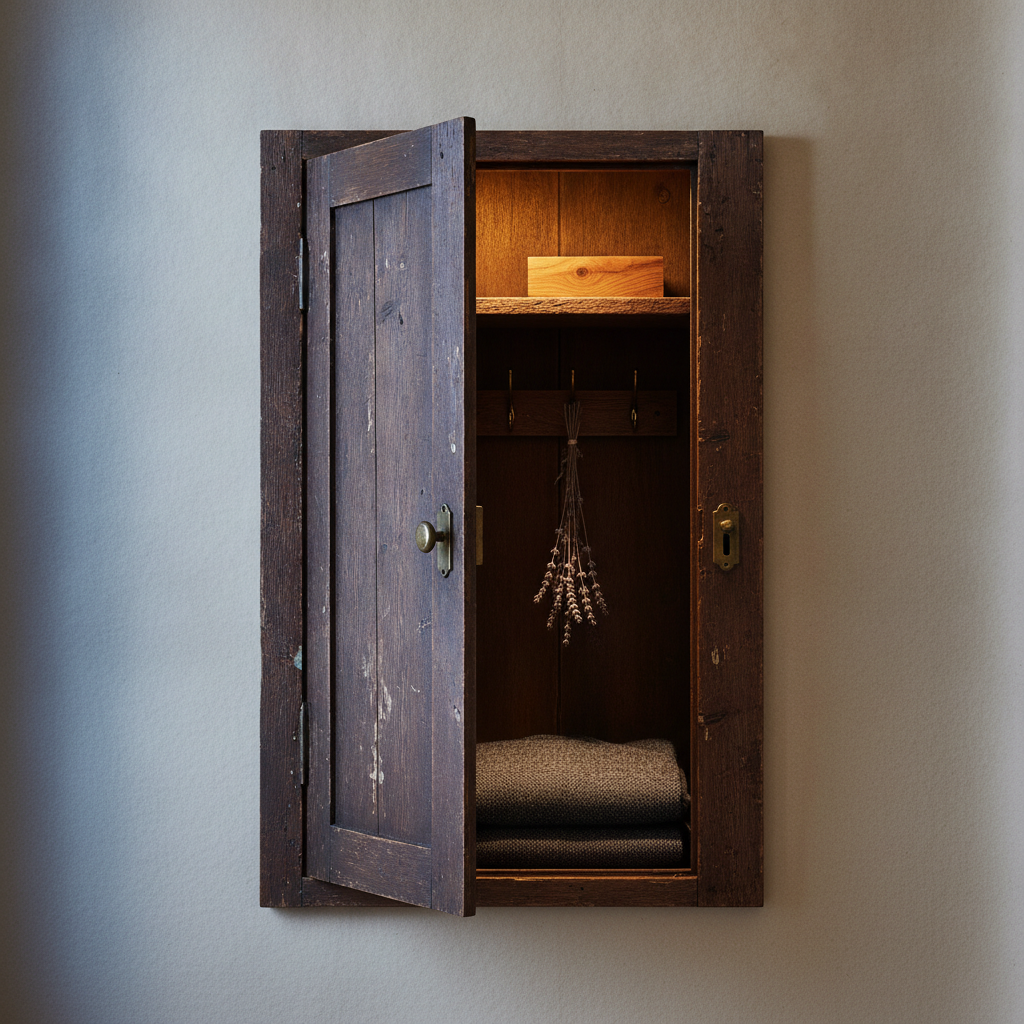
There's a moment at the start of every winter — usually the first week the temperature actually drops and stays down — where something in the cold air catches me off guard. It's not a perfume I'm wearing. It's a smell I'm looking for. Old wool. Cedar. A faint trace of powder. The particular stillness of air that hasn't moved in months.
It's the coat closet at my grandmother's house, and I haven't stood in front of it in years.
Some smells don't just remind you of a place. They are the place — completely, instantly, with no effort at all. You don't recall it so much as step back into it. The light the same angle, the floor the same feel underfoot. Scent memory works faster than any other kind, and it skips right over the part where you know you're remembering. One second you're standing on a pavement in November. The next you're eight years old and the weekend stretches out in front of you.
What was actually in that smell
I've thought about this more than is probably reasonable. The coat closet smell had layers, though I wouldn't have called them that as a child.
There was the wool — heavy coats that had absorbed years of cold air and wood smoke and whatever perfume my grandmother wore on Sundays. Wool holds onto things. It's porous and dense at the same time, and it doesn't give up what it's collected. Then there was the cedar — those small blocks or sachets that were supposed to keep the moths away, dry and faintly sharp, the smell of preservation itself. Underneath that, something powdery. Face powder, maybe, or the particular dry softness of things that have been kept in a dark, quiet place for a long time.
And then there was the cold. Not damp cold — dry cold, the kind that comes off wool coats that have been outside and then brought in. It has a smell, that cold air caught in fabric. Clean and a little sharp, like the outdoors got caught in the lining and stayed there.
Together it was completely unremarkable to me as a child. I walked past that closet every time I visited. I never thought about it. And now I would recognize it anywhere.

Why winter brings it back
Summer doesn't do this to me. Spring doesn't. But the first real cold week every year — that week when you finally pull your own heavy coat out of wherever you've stored it — something in the air or the fabric or the ritual of it snags on something old.
Part of it is probably the smell itself coming back. Wool coats do have a smell when you first put them on again after months. Cedar is a winter-closet smell in a way it simply isn't in July. But I think it's also something about winter as a season of interiors — of closed doors, of warmth that has to be maintained, of the particular quiet of a house that's keeping the cold out. That's the world my grandmother's house existed in, in memory. Winter was when we were most inside it.
There's a piece worth reading about why winter scents carry a different emotional weight when the days get short — the argument there is that darkness and enclosure change how we experience smell, make it more interior, more felt. I think that's right. Winter is when scent memory has the most room to work.
The bottles that come close
People sometimes try to recreate this kind of smell, and I understand the impulse. There are fragrances built around exactly these materials — dry cedar, clean wool, a breath of cold air, something powdery and still. Some of them are very good. Woody fragrances that manage warmth without going heavy sometimes land in the same territory: that dry, slightly resinous quality that cedar has when it's old and settled rather than sharp and fresh.
But none of them are quite right, and I don't think any of them can be. The smell I'm looking for isn't just cedar and wool. It's cedar and wool in that closet, which means it also contains every coat that ever hung there, every winter that passed, my grandmother's particular way of keeping things. That's not something a perfumer can bottle. It lives only in the original and in whatever part of my brain filed it away before I knew I was keeping it.
What I've found is that certain fragrances don't recreate the memory so much as they open the door near it. They share enough of the vocabulary — dry wood, quiet powder, something cool — that the rest comes in on its own. That's probably as close as it gets.

Writing it down before it fades
The strange thing about scent memory is that you can't look at it directly. You can't summon it the way you can summon a name or a face. It arrives on its own, and when it does, it's vivid for a moment and then it's already beginning to go. You come home from a walk in cold air and you had it, you really had it — the closet, the wool, the whole house — and by the time you sit down it's softened into something more general.
I've started trying to write those moments down. Not elaborate descriptions, just enough to hold the shape of it. What the smell was, what it brought back, when it arrived. There's something in the quiet practice of keeping a scent diary that I didn't expect: you start to notice how often these moments happen, and how quickly they pass when you don't catch them.
The memories don't need to be about a perfume you own. They can be about a coat closet, a grandmother's house, the first cold week of a year that's almost gone. Those are worth keeping too.
TheScentStyler's Historian feature does something I find quietly remarkable: at the end of a week of entries, it builds a short written narrative from what you logged — what you wore, what you noticed, what the week felt like through scent. It's not a list. It's closer to a memoir paragraph. If you start writing down the memories that arrive this winter, that's the kind of thing it can help you hold onto.
Keep reading The Drydown
The Drydown publishes a new piece most days. If you’d like them quietly delivered, leave your email — no noise, just the writing.
One email per new piece. Unsubscribe anytime.