
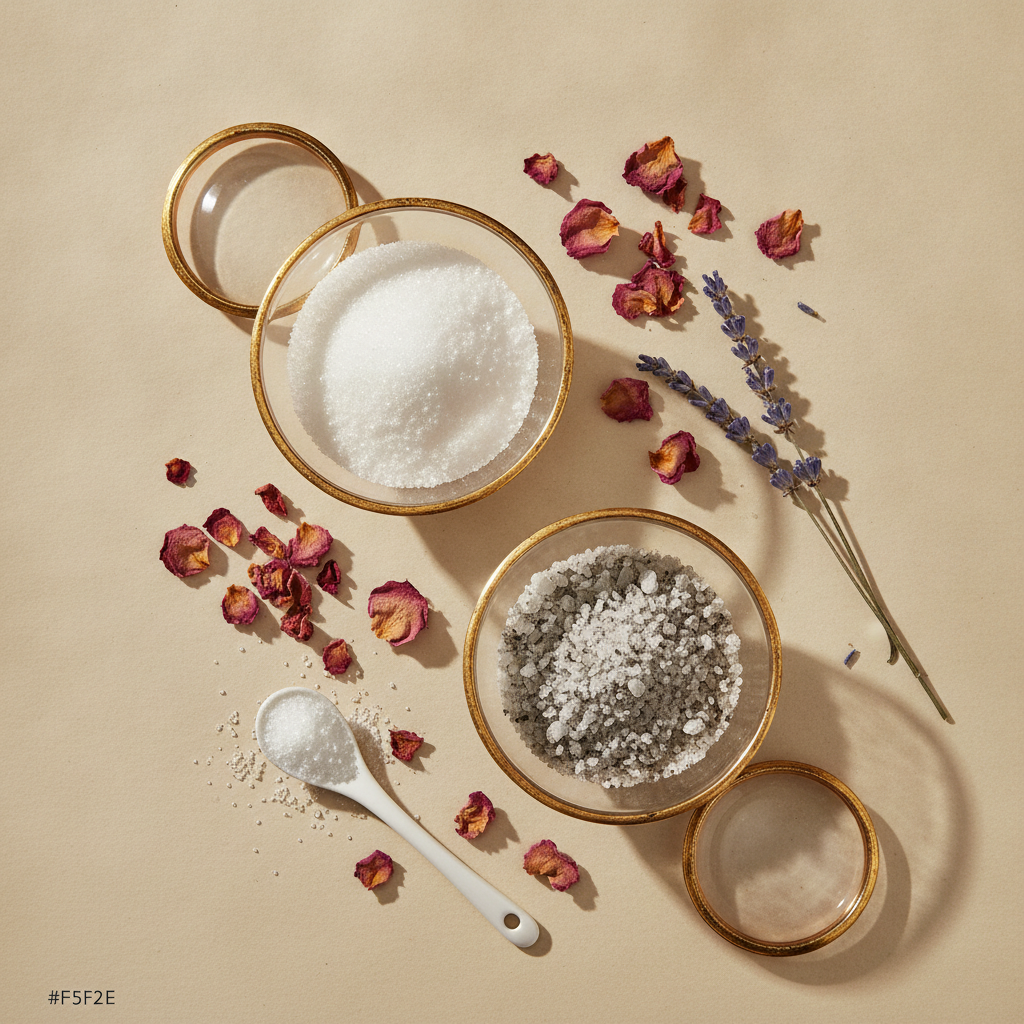
If you've ever walked out of the shower after a scrub and reached for your perfume, you already know skin prep and scent are linked. But the scrub you choose — salt or sugar — actually matters more than most people realize. Not just for your skin, but for how well a fragrance sticks to it afterward.
Here's the honest breakdown.
The difference starts with the grain
Salt and sugar crystals are not interchangeable. Salt — usually sea salt or Himalayan — is harder, denser, and has sharper edges. Sugar is softer, dissolves faster, and has a rounder grain. You can feel this difference the moment they hit wet skin.
That hardness is why salt scrubs feel more intense. The crystals don't break down right away, so they keep abrading as you rub. That's genuinely useful on thick, calloused skin — heels, elbows, the soles of your feet — where you want serious exfoliation and you're not too worried about tenderness afterward.
Sugar behaves differently. It starts to dissolve as soon as it makes contact with water, which softens the whole process. You still get exfoliation, but it's gentler — better suited to skin that's going to be touched, exposed, or layered with something fragrant right after.

What salt does to moisture — and why that matters
Here's the part most scrub conversations skip. Salt is hygroscopic, meaning it pulls moisture toward itself. In a body scrub context, that's mostly fine — it rinses off, and you moisturize afterward. But if you skip that step, or apply a fragrance before your skin has fully recovered its moisture balance, you can end up with drier skin. And dry skin, as anyone who's fought with longevity knows, is not great for holding scent.
This is one of the reasons fragrance tends to perform better on well-moisturized skin — the oils and hydration in your skin give fragrance molecules something to cling to. Salt scrubs aren't bad for that goal, but they require a deliberate recovery step: rinse thoroughly, give your skin a moment, then apply a lotion or oil before anything fragrant.
Sugar is more forgiving here. Many sugar scrubs are already blended with a carrier oil — coconut, jojoba, sweet almond — so they leave a thin, conditioning film on the skin as they rinse. That residue is mild, but it means your skin is closer to ready for fragrance application immediately after. Less of a gap between scrubbing and spritzing.
Where you're scrubbing changes everything
Think about where you actually apply perfume. Wrists. Inner elbows. The curve of the neck. Behind the knees. These are pulse points — warm, thin-skinned, and relatively delicate. They're also exactly where you don't want to use a harsh salt scrub right before fragrance, because irritated or over-exfoliated skin and alcohol-based perfume are not a comfortable combination.
Salt scrubs are better kept to the zones that need the work: feet, knees, elbows, the backs of heels. Sugar scrubs are the sensible choice for everywhere else — specifically anywhere you plan to layer fragrance afterward.
If your body care routine involves building a full scent ecosystem — a matching lotion, a body oil, then your perfume — then the scrub you use on those application sites should be setting the stage, not roughing it up. Sugar does that better.
The scented scrub question
A lot of scrubs — especially from body-focused fragrance brands — come pre-scented. And here's where it gets interesting from a fragrance perspective: a scented sugar scrub can actually be a first layer in your scent routine, especially if you're using it on pulse-point areas.
Because sugar scrubs tend to leave a slight oil residue, the fragrance in them has something to anchor to. The scent won't last for hours — it's a scrub, not a perfume — but it creates a warm, faintly scented base that your actual perfume can build on. That layering effect is mild but real.
If you want to try this properly, the most straightforward approach is a three-ingredient DIY — sugar, a neutral carrier oil, and a drop or two of something you already wear. There's a simple guide to making a scented sugar scrub that actually leaves scent behind if you want to go that route.

The short answer
Use salt where you need serious exfoliation and you're not planning to apply fragrance right after — feet, elbows, tough spots. Give your skin time to rehydrate before anything scented goes on.
Use sugar on the rest of your body, especially anywhere in your fragrance routine. It's gentler, it leaves skin in better shape for scent application, and if it's oil-based, it can function as an early layer in your routine rather than just a prep step.
Neither one is objectively better. They're tools for different jobs. The question is just whether you're scrubbing to exfoliate — or scrubbing to wear something beautiful afterward.
If you're building out a scented body care routine and want to keep track of what layers well together, TheScentStyler has a Librarian feature that catalogs your fragrances and fills in their notes and DNA — useful when you're trying to figure out which scrub scent, lotion, or oil is going to complement rather than clash with what you spray on top.
Keep reading The Drydown
The Drydown publishes a new piece most days. If you’d like them quietly delivered, leave your email — no noise, just the writing.
One email per new piece. Unsubscribe anytime.