
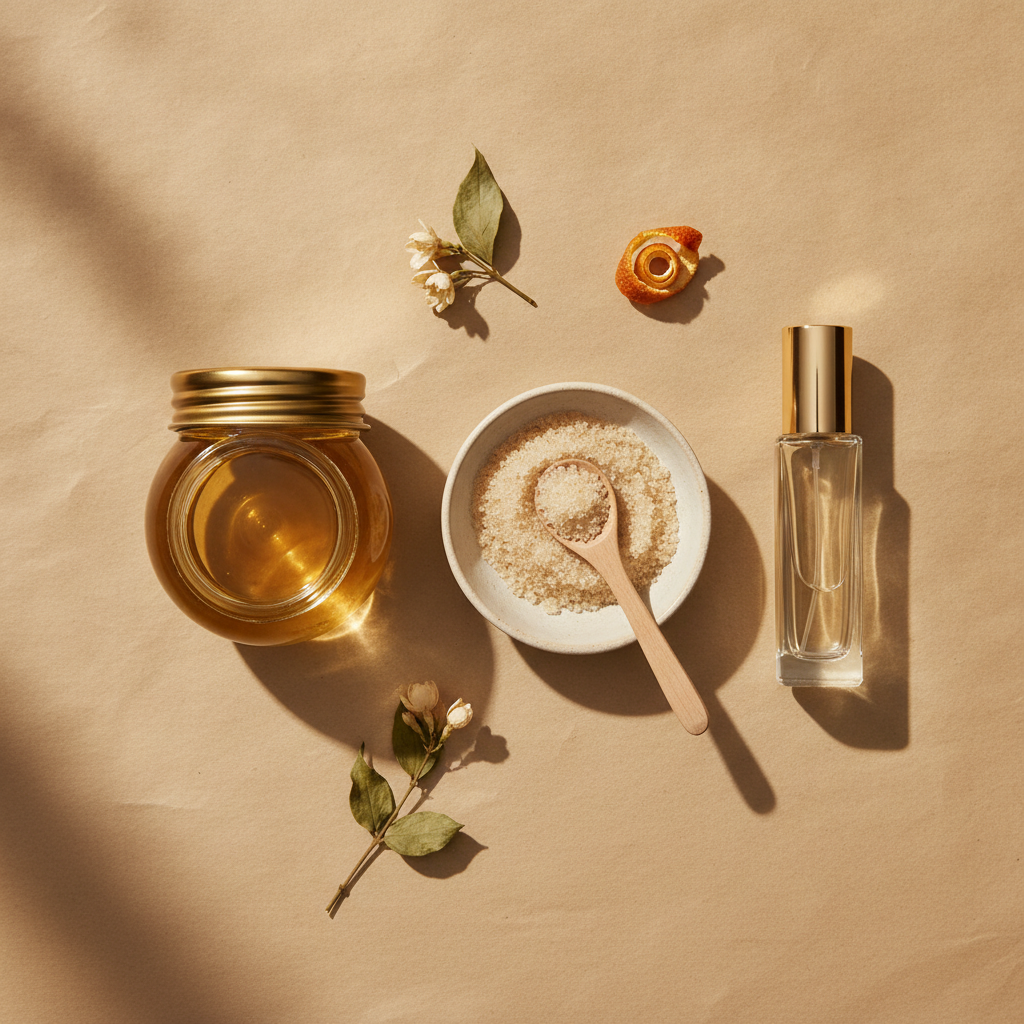
Most of us learned fragrance application the way we learned most grooming habits — by watching someone else and filling in the gaps ourselves. Spray your pulse points. Maybe moisturize first. That's about it.
Which means almost nobody learned the step that comes before the moisturizer, or why the order actually matters. There's a sequence that makes everything work better — your exfoliator, your body oil, your perfume — and it's not complicated once you see the logic behind it.
Step one: Exfoliate first, and mean it
Skin cells are constantly shedding. That's just biology. But when there's a visible buildup of dry or dead skin on the surface, fragrance — and oil — can't really anchor to anything useful. They sit on top of what's already loose, and they leave with it.
Exfoliating first isn't about being meticulous. It's about giving everything that follows a clean surface to land on. Freshly buffed skin is more receptive. Oil absorbs into it rather than sitting on top of it. And when the oil goes in properly, perfume has something real to cling to.
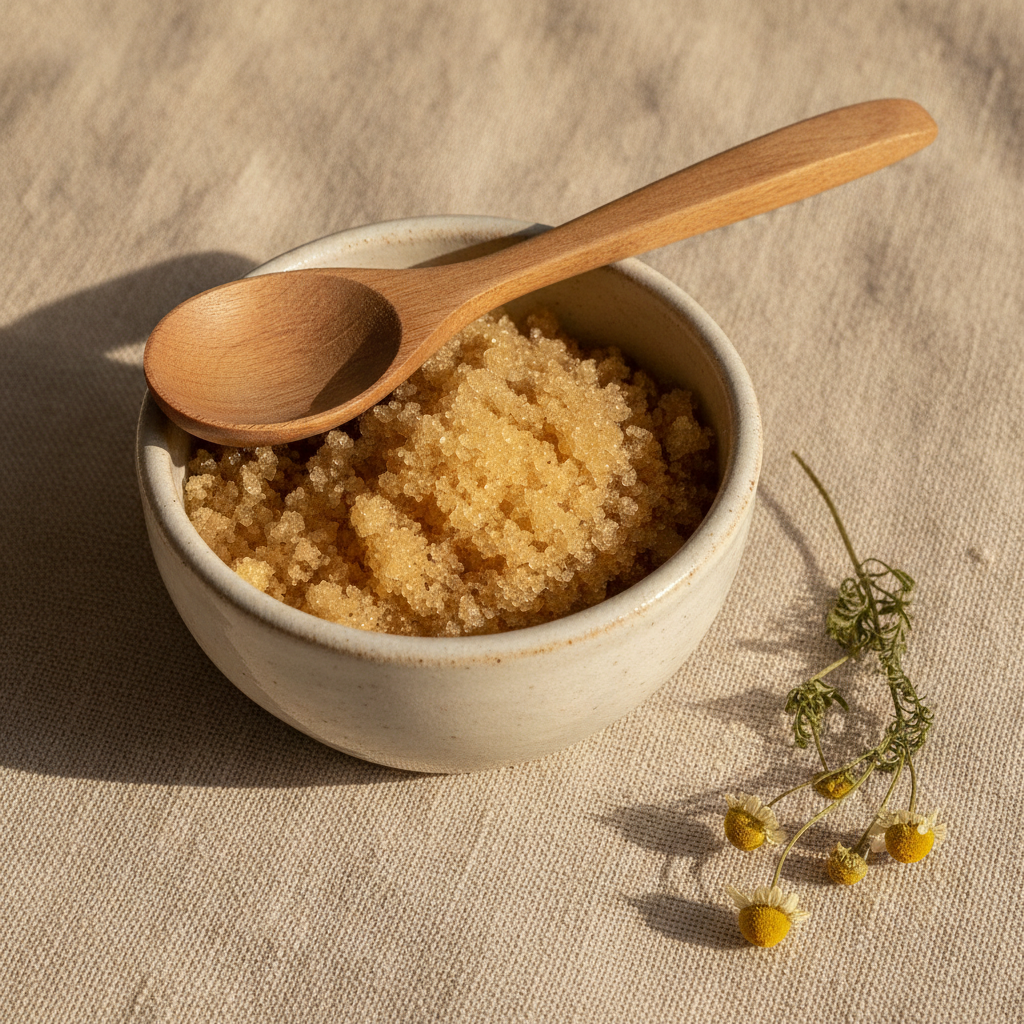
How often? A couple of times a week is plenty. You don't need to scrub like you're stripping paint. If you want to understand the difference between exfoliant types before you pick one, the case for sugar over salt on scented skin is worth a quick read — they behave differently and suit different skin types. And if you want to go further and make your scrub part of the scent ritual itself, a three-ingredient scented sugar scrub can actually carry fragrance into the skin before your perfume even goes on.
Step two: Apply oil while your skin is still warm
Right after you shower — when your pores are open and your skin is still a little warm — is when body oil does its best work. It absorbs quickly and evenly instead of sitting in patches. This is the window.
Massage it in while your skin is damp, not soaking wet but not fully dried off either. The warmth helps it sink in. You don't need much. A few drops on the palms, worked into your arms, chest, and wherever you tend to spray perfume, is enough.
The oil does two things here. First, it actually moisturizes — which is useful on its own. Second, and this is the part most people don't think about, it creates a slightly tacky surface for fragrance molecules to bind to. Dry skin is essentially porous and rough at a microscopic level. Oiled skin is smooth, slightly coated, and gives the perfume something to hold onto rather than evaporating straight off.
If you're pairing a scented body oil with your perfume (rather than a plain carrier oil), the scent layering question gets more interesting — how to do that without muddying either scent goes into the specifics of matching and contrast.
Step three: Perfume on top, not underneath
This is where the order clicks into place. Once the oil has been given a moment to absorb — not bone dry, but not slick either — you spray your fragrance on top.
The fragrance now has somewhere to land that's receptive to it. The oil has slightly slowed down moisture loss from the skin, which means the warmth that helps a scent bloom stays present longer. The whole thing performs better than it would on bare, dry skin.
What you want to avoid is reversing steps two and three. Spraying perfume first and then applying oil on top effectively seals the fragrance away — or worse, dilutes the top notes before they've had a chance to open. The oil becomes a lid rather than a foundation.
Pulse points still apply here: wrists, inner elbows, the base of your throat. Warm spots on your body push scent outward. The oil doesn't change that — it just makes the whole thing last longer and smell more like itself.

Why this isn't just a longevity trick
If you want a full breakdown of everything that affects how long fragrance lasts on your skin, the longevity guide covers it thoroughly. But the sequence above is doing something different — it's not just about making scent last longer, it's about making it smell better from the start.
Fragrance behaves differently on well-prepared skin. The dry-down — the way a scent settles and shifts as it wears — happens more smoothly when the base has somewhere to go. You get a cleaner read on the heart and base notes because the top notes have room to do their job and then fade gracefully rather than burning off all at once.
That's the difference between spraying perfume on dry, unmoisturized skin and doing it this way. Same bottle, different experience.
If you're building out a real layering practice — thinking about which oils pair well with which perfumes for which seasons or moods — the Atelier inside TheScentStyler is built for exactly that. It looks at what you have and suggests combinations and pairings based on what you actually own. Worth exploring once you know your sequence.
Keep reading The Drydown
The Drydown publishes a new piece most days. If you’d like them quietly delivered, leave your email — no noise, just the writing.
One email per new piece. Unsubscribe anytime.