
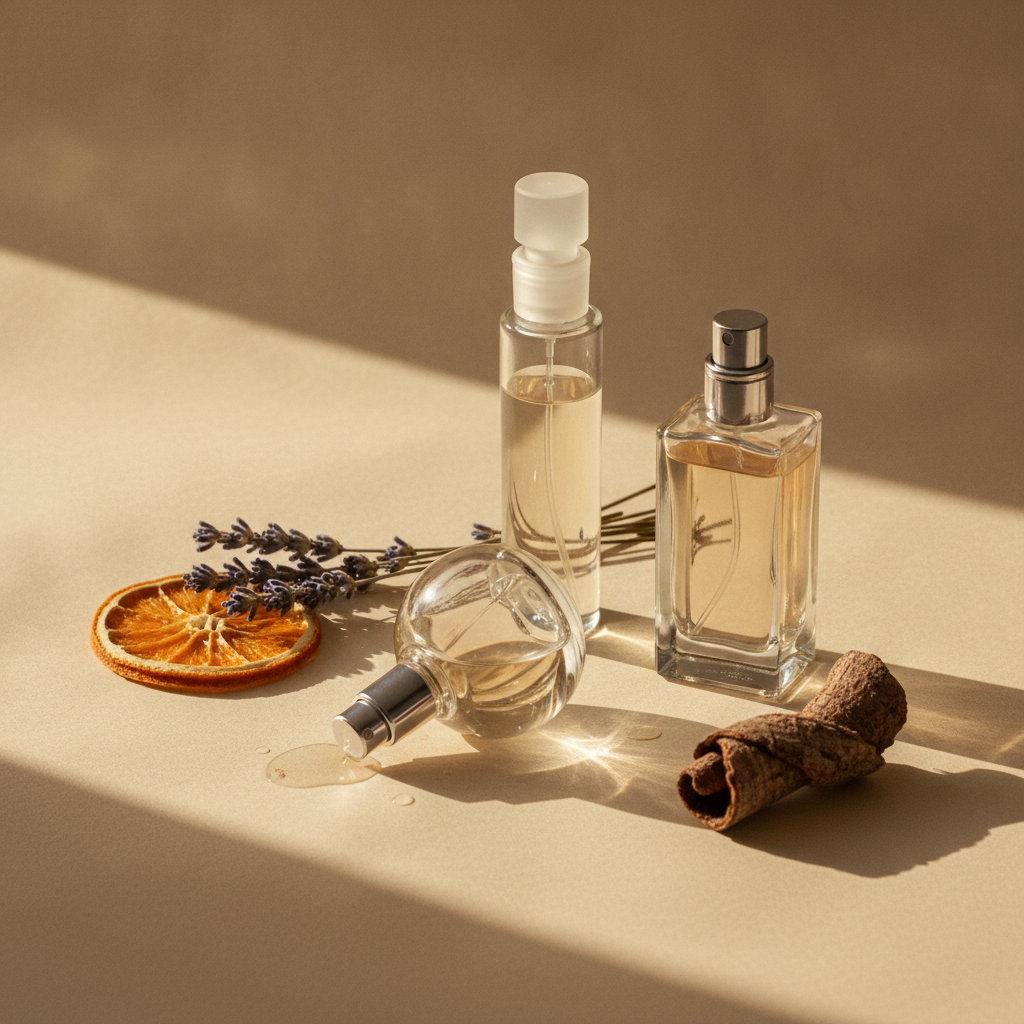
Pull out your bottles. Not to organize them — just to look.
There's a record here, if you want to read it. Not the kind you kept on purpose, but the kind that forms anyway, quietly, over twelve months of reaching for one thing and leaving another untouched. The half-empty ones tell you something. So do the full ones. So does the bottle you moved to the back of the shelf and haven't touched since August.
A fragrance year in review isn't really about perfume. It's about the shape of the year itself, seen from a sideways angle.
The one you wore to death
Every year seems to have one. You didn't plan it that way — you reached for it one morning because it felt right, and then you kept reaching, and then it was just the one you wore for a stretch of months without thinking about it.
There's usually something behind that. Not always something dramatic, just something consistent: a period of steadiness, or a period of needing steadying. Comfort fragrances get worn that way. So do ones that feel like armor — a projection scent you wore through a stretch when you needed to feel capable. The bottle that's nearly empty isn't evidence of a favorite so much as evidence of a season of yourself.
What was happening when you were reaching for it? Worth sitting with that for a moment.
The one you bought in a good month and never opened again
This one's interesting. You were in a particular mood when you bought it — hopeful, probably, or celebratory, or just feeling expansive. And then life shifted, the mood passed, and the bottle sits there full, slightly accusatory.
Sometimes that's just the ordinary fickleness of taste. But sometimes it's a snapshot of a version of yourself that didn't quite stick around. The amber you bought in October when you were feeling bold and then couldn't bear to wear in November when you weren't. The optimistic floral that got a few sprays in June and then the summer went sideways.
You don't have to do anything about it. What to do with a perfume you don't love is a practical question with practical answers, but that's not actually the point here. The point is just to notice: that bottle is a small portrait of a specific you, at a specific moment. It's not a waste. It's data.
The one you can't wear anymore
This is the hardest category, and not everyone will have one — but if you do, you know it immediately.
It might be that a scent got permanently attached to someone, and now wearing it is too much. It might be that it lived on the edge of a hard stretch and carrying it forward feels like carrying something you'd rather set down. It might be something subtler — a version of yourself the scent belonged to, a context that no longer exists.
There's no prescription here. You don't have to get rid of it, and you don't have to force yourself to reclaim it. Just knowing which bottle it is, and why, is enough. That's not failure. That's the year having actually happened to you.
The one that surprised you
Usually there's one of these too. Something you picked up idly, or reached for on a slow Tuesday for no particular reason, and found it met you differently than expected. A scent you'd written off as too sweet that suddenly made sense in March. A sample that got promoted to full bottle because you kept grabbing it.
These are the pleasant data points. They tend to mark the months where you were a little more open, a little less locked into what you thought you were supposed to like. How fragrance taste changes over time is a real thing — and usually the year's surprise bottle is evidence of it in motion.
The quiet pattern underneath
When you lay all of that out — the worn-down one, the untouched one, the one you can't wear anymore, the one that caught you off guard — something starts to take shape. Not a lesson exactly. Not a tidy throughline. Just a sense of the year's texture, the emotional weather of it, recorded in the only way you probably weren't being self-conscious about.
There's something useful in that. We're careful about what we write down, what we say out loud. But the perfume you grabbed at seven in the morning, half-awake, is pretty honest data.
The TheScentStyler Historian feature does something with this that I find quietly remarkable: feed it a week of logged wears and it turns them into a short narrative of your scent life — not a list, an actual story, written back to you in your own terms. Do it across a year and you have something closer to a memoir than a catalog.
You don't need to make anything of this. You don't need a resolution or a theme word or a plan for next year's rotation.
You just need to look at the bottles, notice which ones are low and which ones are full and which ones you've moved without quite knowing why, and let that be the year, held in glass, sitting quietly on your shelf.
That's the review. Start logging what you reach for next year, and see what it says about that one too.
Keep reading The Drydown
The Drydown publishes a new piece most days. If you’d like them quietly delivered, leave your email — no noise, just the writing.
One email per new piece. Unsubscribe anytime.