
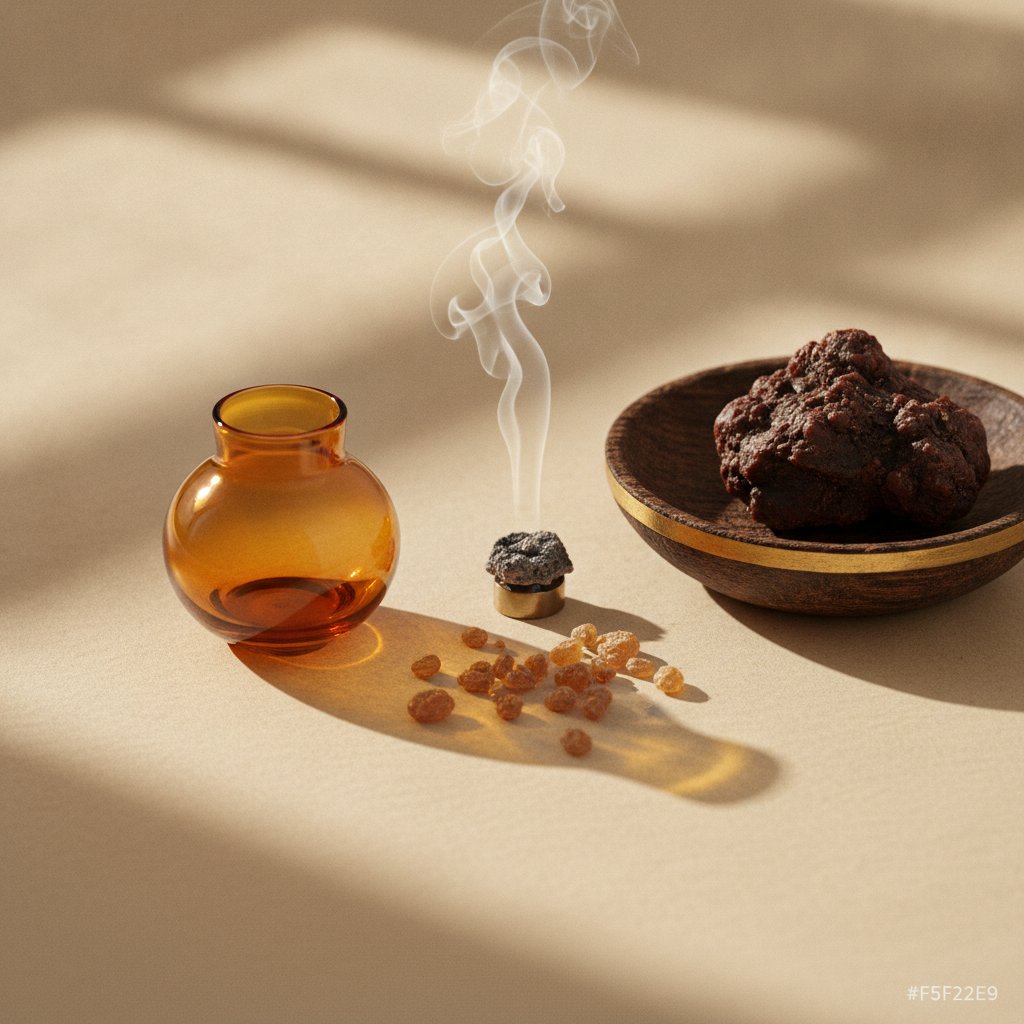
If you grew up going to any kind of religious service — Catholic, Orthodox, Anglican, certain Buddhist or Hindu temples — you probably already know what incense smells like without realizing you know it. That particular smell: smoke that's somehow clean, a dryness at the back of your throat, something ancient and a little serious. Perfumers have been reaching for it for centuries, and in cold weather especially, it shows up everywhere.
But "incense" in a perfume context isn't one single thing. It's a family of materials, each with its own character. Understanding them takes about five minutes, and afterward you'll read fragrance descriptions in a completely different way.
The core of it: smoky, dry, and a little sacred
The easiest way to describe incense in perfume is this: imagine warm smoke that doesn't smell like a campfire. Where wood smoke is rustic and outdoor, incense smoke is drier, more mineral, sometimes faintly peppery. It has a coolness underneath the warmth — almost like stone or ash — and a quality that some people describe as "spiritual" or "churchy." That word gets used a lot, and it's accurate. Churches that burn resin over coals create exactly the smell that perfumers are reaching for.
What makes it work in a bottle is that incense notes tend to sit close to the skin. They don't shout. They're quiet and dense, which is part of why they suit winter — layered clothing, indoor warmth, lower humidity — the conditions where a scent can really settle and develop.
The three you'll see most
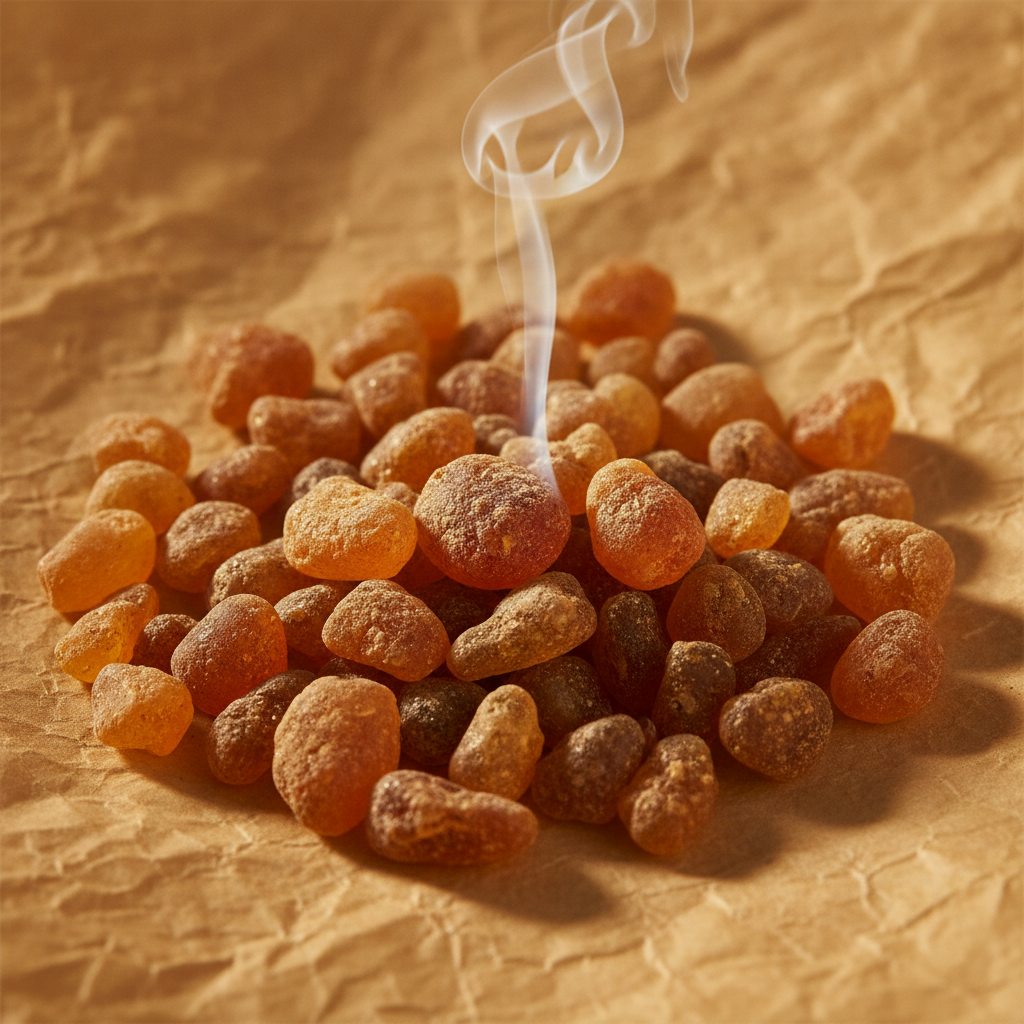
Frankincense (sometimes listed as olibanum) is the classic. When you smell it in isolation, it's sharp at first — a green, almost citrusy top note — then it settles into something dry and resinous, slightly woody, with that powdery smoke quality. It reads as clean rather than heavy. In a perfume, frankincense tends to add a kind of elevation: it lifts what's around it without making the fragrance feel lighter. It's the most wearable of the three for people who are new to incense notes.
Myrrh is darker and sweeter. Where frankincense is dry, myrrh has a slight earthiness and a warm, almost medicinal quality — bitter in an interesting way, the way dark chocolate is bitter. It pairs well with amber and spice, which is why you often see it anchoring winter and holiday scents. If a fragrance is described as "deep" or "ancient-smelling," myrrh is often doing some of the work.
Benzoin is the most accessible of the three, especially if you're coming to incense from warm, sweet amber and vanilla territory. It's resinous and slightly balsamic, but rounded — almost vanilla-adjacent, with a warm, soothing quality. Less smoke, more depth. Benzoin tends to make a fragrance feel cozy rather than solemn, which is why it often bridges incense and gourmand territory.
These three often appear together, layered in different proportions. When you see a fragrance described as "resinous," the perfumer likely means a blend of all three, adjusted to taste.
Who loves incense, and who finds it too much
People who gravitate toward incense notes in perfume tend to appreciate restraint. They usually prefer depth over brightness, quiet over loud. If you already reach for woody or leather scents — or if you liked the way oud sits close and dense on skin — incense is probably in your wheelhouse.
If you typically prefer citrus, aquatics, or light florals, straight incense might feel like a lot at first. The smokiness can read as oppressive in certain formulations, or it can just feel "too serious" for everyday wear. That's a completely reasonable reaction, and it doesn't mean the note is wrong for you permanently — skin chemistry plays a huge role, and sometimes a frankincense note that feels heavy in the bottle opens up on your skin into something austere and elegant. The only way to know is to try it.
The good middle ground for skeptics: look for fragrances where incense is listed as a base note rather than a top note, or where it's paired with something luminous or green. That tends to soften the smoke and bring out the cleaner, drier facets of frankincense in particular.
Why incense belongs in winter
There are a few reasons incense clusters in cold-weather fragrances. The practical one: heavier, resinous notes need warmth to project, and in winter your skin is indoors, close to your clothes, which creates the ideal environment. A fragrance that smells almost invisible in summer heat — too close, too quiet — can open up beautifully under a wool coat.
The less practical but more interesting reason: incense has a psychological warmth. It smells ancient, protected, like a room that's been inhabited for a long time. That's exactly the feeling cold months seem to call for. If you've ever noticed that certain scents just feel like winter in a way that's hard to explain, incense is often why — even when it's not the star of the show.
It works particularly well alongside the warm, spicy fragrances that make for good sweater-weather wearing — cardamom, clove, black pepper — because the smoke and the spice have a similar directness. They don't hide.
A note on concentration and collection
Incense tends to be most present in eau de parfum and parfum concentrations, where it has room to develop across the drydown. In an EDT, the resinous quality can feel thinner or it might disappear before the afternoon is out.
If you're trying to figure out which of your current bottles leans incense — or you want to track how a resinous fragrance changes on your skin over a few hours — that's exactly the kind of thing a scent catalog is useful for. TheScentStyler can fill in the note breakdown of what you own through the Librarian feature, so you can see at a glance which bottles in your collection share this DNA.
Cold weather is a good time to sit with a new note properly. Wear it on a slow afternoon, pay attention to how it shifts, and you'll understand incense in a way no description can quite replace.
Keep reading The Drydown
The Drydown publishes a new piece most days. If you’d like them quietly delivered, leave your email — no noise, just the writing.
One email per new piece. Unsubscribe anytime.